
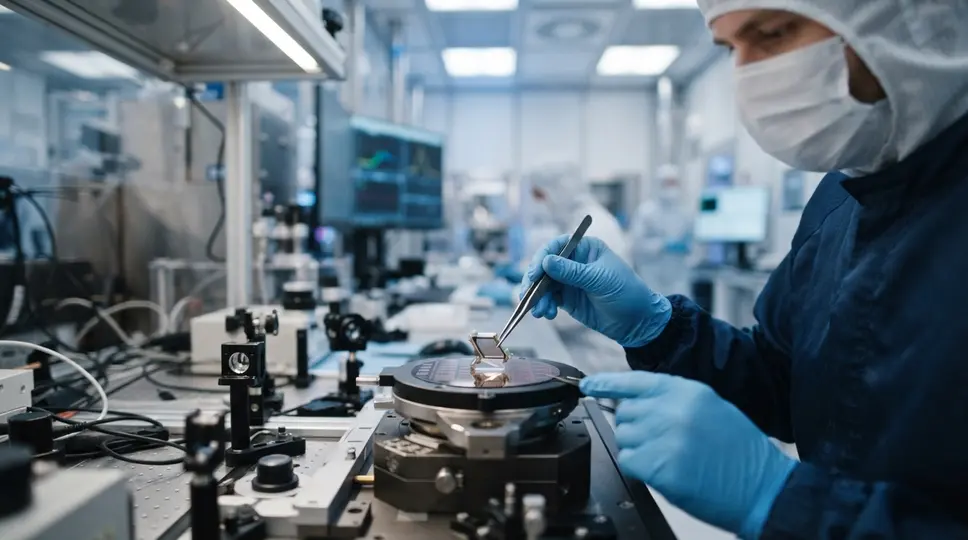
Jena, September 01, 2026. The European Earth observation satellite FLEX is preparing for its launch into space. To analyze photosynthesis and the health status of plants worldwide from an altitude of approximately 815 kilometers, the European Space Agency (ESA) is relying on high-precision technology from Jena.
- Event: Launch of the ESA satellite FLEX with optics from Jena
- Date: Scheduled for September 15, 2026
- Participation: Fraunhofer Institute for Applied Optics and Precision Engineering IOF (Jena)
- Core components: Double-slit assembly (85 µm width) and special mirrors
During photosynthesis, plants emit a tiny fraction of the absorbed solar energy as fluorescence, which is invisible to the human eye. The Fraunhofer IOF, under contract to OHB System AG, developed a crucial optical key component for the onboard FLORIS spectrometer: a silicon double-slit assembly.
Technical Masterpiece from Jena: Slits and Mirrors
The two slits of the assembly are each 44.15 millimeters long but only 85 micrometers wide – comparable to the thickness of a human hair. The manufacturing requirements in the cleanroom were extreme: over the entire length, the width must not deviate from the target value by more than one micrometer. To prevent disruptive reflections, the slits were also given a special black coating.
During the subsequent assembly at the Abbe Center of Photonics and the institute, fractions of micrometers were also critical. The elements had to be positioned highly parallel to the apertures. In addition to the slits, the Jena researchers manufactured two mirrors for the spectrometer, whose surfaces exhibit an extremely low roughness of only 0.3 nanometers rms – this corresponds to approximately the distance of one to two atomic layers.
⭐⭐⭐⭐⭐ 4.8 / 5
Magnifying glass with LED for technology and precision mechanics
Handy professional magnifier with strong magnification for detailed examinations.
Background: Global Climate and Vegetation Research
Measuring sun-induced chlorophyll fluorescence from space is intended to provide science with precise insights into the global carbon and water cycle in the future. FLEX does not provide detailed images of individual plants, but captures large-scale vegetation data with a spatial resolution of approximately 300 by 300 meters. This allows researchers to detect drought or heat stress in some cases before visible damage occurs on the ground. The launch of the Vega-C rocket from the spaceport in Kourou is scheduled for mid-September 2026.
Source:
Satellite to detect plant stress from 815 km altitude with precision optics from Jena
Transparency note: This article was created automatically, editorially reviewed, and expanded with AI support.