
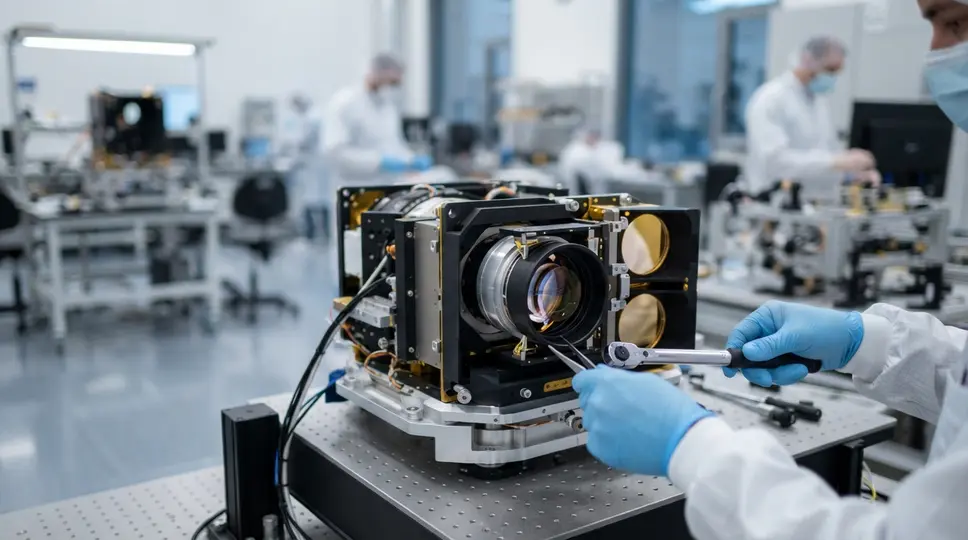
Jena, September 2, 2026 – When the European Space Agency’s (ESA) Earth observation mission FLEX launches into space as scheduled on September 15, 2026, cutting-edge technology from Jena will be on board. Researchers from the Fraunhofer Institute for Applied Optics and Precision Engineering IOF have made significant contributions to the satellite’s scientific instrumentation.
- Event: Launch of the ESA mission FLEX with technology from Jena
- Date: September 15, 2026
- Participating Institution: Fraunhofer Institute for Applied Optics and Precision Engineering (IOF) Jena
- Core Task: Monitoring photosynthetic plant activity from space
Technological Significance of the Jena Contribution
For the spectrometer installed on board the satellite, the Fraunhofer IOF has developed and manufactured a silicon-based double-slit assembly as well as two high-precision mirrors. These optical components are among the most demanding parts of the measuring instrument, as they must withstand extreme physical stresses during launch and in orbit while requiring the highest level of optical precision.
The spectrometer’s task is to measure the faint, sunlight-induced fluorescence of plants from Earth’s orbit. This so-called “glow” of vegetation is invisible to the naked eye but provides scientists with precise data on photosynthetic activity.
Why the components are crucial for space research
The optical components from Jena enable the satellite to precisely resolve the smallest spectral changes in the light reflection of plants. This allows researchers worldwide to monitor the health status, drought stress, and global ecosystem processes in real-time. This is a decisive step forward for climate and agricultural research in identifying crop failures early and better understanding global vegetation changes.
⭐⭐⭐⭐⭐ 4.8 / 5
Hiking Map Saaletal & Jena: Precise Topography
Ideal for those who want to explore the local nature and the surroundings of Jena.
Background: Research and Precision Engineering in Jena
Jena has a long tradition in high-precision optics and precision engineering, which is strongly linked to names like Carl Zeiss and Ernst Abbe. Today, university institutions and non-university research institutes such as the Fraunhofer IOF continuously drive this technological development, positioning the location as an internationally leading center for photonics and space optics.
Source:
Making plant health visible from space
Transparency note: This article was created automatically, editorially reviewed, and expanded with AI support.