
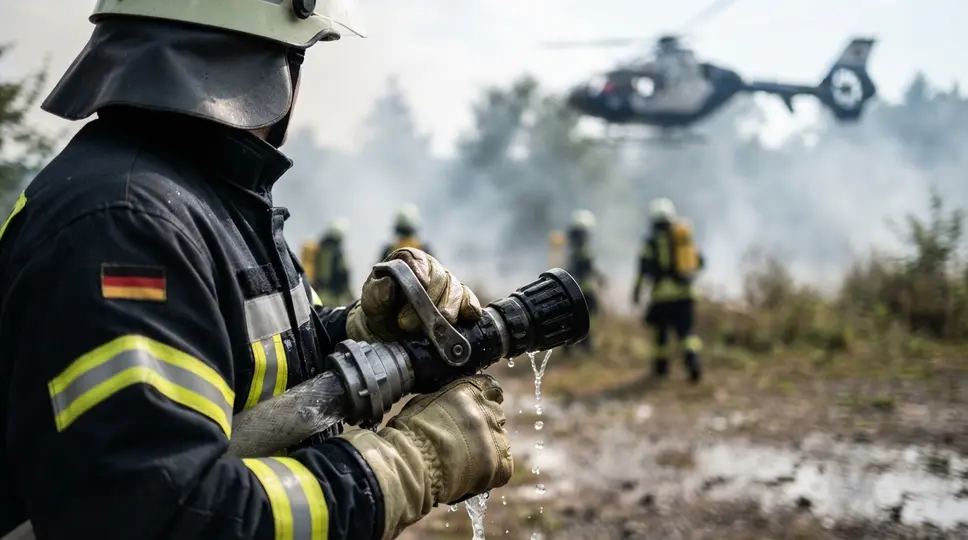
Ohrdruf/Jena, July 9, 2026 – Firefighter candidates from the current Jena basic training course are currently undergoing intensive practical training at the Ohrdruf military training area. The week-long training under realistic conditions is designed to prepare the prospective emergency personnel for complex emergency scenarios.
- Event: Practical training of the 9th basic firefighter course
- Location: Truppenübungsplatz Ohrdruf (Gotha district)
- Course duration: 6 months (Start: April 1, 2026), approx. 980 teaching hours
- Participants: 16 candidates (including from Jena, Berlin, Rudolstadt, Nordhausen, Ilmenau)
- Key cooperation partners: Thuringian Police Helicopter Squadron, Bundeswehr
Demanding practical days at the military training area
The training on the expansive 4,287-hectare military site in Ohrdruf is one of the toughest and most important sections of the six-month basic course. The primary goal of this intensive practical week is to consolidate theoretically acquired skills under realistic conditions. For the 16 participants from various Thuringian municipalities, the Berlin Fire Department, and industry (TotalEnergies Leuna), the site provides the necessary infrastructure for large-scale exercises.
Mayor and Head of Security Benjamin Koppe, as well as Nick Ludwig, Head of the Jena Fire Department, visited the training camp on-site to assess the performance level of the prospective firefighters. Koppe emphasized the uniqueness of the location: “The military training area offers ideal conditions to train emergency situations under realistic prerequisites. It is precisely these exercises that create the necessary routine and security so that every movement is instinctive in an emergency.”
Cooperation with the Thuringian Police Helicopter Squadron
A key focus of the training week was the suppression of vegetation fires. In this regard, the emergency forces worked closely with the Thuringian Police helicopter squadron. A controlled straw fire was ignited on the grounds for this purpose. The candidates practiced situational awareness as well as direct fire suppression on the ground.
They were supported from the air by a police helicopter, which performed precise drops using a fire-extinguishing water tank with a capacity of approximately 900 liters. This cooperation between police and fire departments is crucial to ensure rapid and coordinated fire suppression during real forest and field fires. Such complex scenarios are regularly among the major challenges in the local emergency services sector.
Pushing limits day and night
The training week demanded everything from the participants, both physically and mentally. In addition to vegetation fire suppression, other demanding exercise scenarios were on the agenda:
- Fires in multi-story buildings using breathing apparatus
- Technical assistance in severe traffic accidents with trapped persons
- Rescue of buried persons from rubble
- Search and rescue missions in total darkness in difficult terrain
The training aims to ensure that the candidates remain capable of acting even under extreme physical exhaustion, communicate within a team, and assume leadership responsibility.
Strategic importance for securing skilled labor in Jena
Jena plays a central role in training within Thuringia. In the current course, the city is not only training for the needs of its own professional fire department but is also acting as a service provider for other cities and companies. “Well-trained firefighters are a central prerequisite for safety in our city. Jena is making an important contribution to securing skilled labor in the fire service sector,” Mayor Koppe concluded.
The main location for the entire six-month training is the Feuer- und Rettungswache Süd in Jena, supplemented by courses at the Thüringer Landesfeuerwehr- und Katastrophenschutzschule in Bad Köstritz.
🛡️ Prevention & Background: Training in Thuringian Fire Protection
Training for the intermediate fire service in Thuringia requires a strict selection process. During the six-month basic course, participants complete approximately 980 teaching hours. In addition to fire suppression and technical assistance, the training also includes medical basics of first aid, hazard theory, breathing apparatus and stress exercises, as well as obtaining the lifeguard badge. Through the cooperation of various municipalities and industry, a uniformly high safety standard in fire and disaster protection is guaranteed nationwide.
Source:
Feuerwehr Jena in Ohrdruf
Transparency note: This article was created automatically, editorially reviewed, and expanded with AI support.