
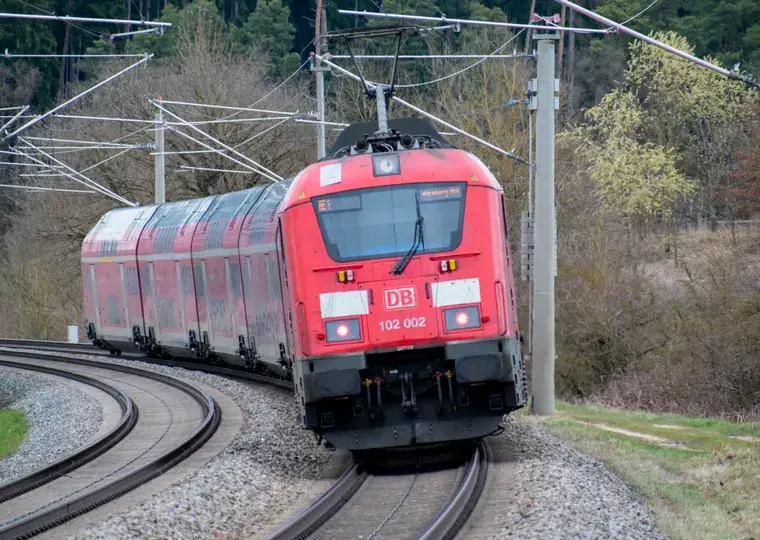
Jena, June 9, 2026. The urgently needed expansion of the Mitte-Deutschland-Verbindung between Weimar and Gößnitz continues to stall due to a massive funding gap of 600 million Euros. Despite political declarations of intent from Berlin, the construction start in 2027, which is vital for Jena and the entire region of Ostthüringen, remains uncertain.
- Project: Double-track expansion and electrification of the Mitte-Deutschland-Verbindung (Weimar–Gößnitz, 115 km)
- Funding Gap: Around 600 million Euros are missing from the current federal budget
- Responsible: Federal Minister of Transport Patrick Schnieder (CDU), Thüringen’s Minister of Transport Steffen Schütz (BSW)
- Relevance for Jena: Directly affected are the stations Jena-West and Jena-Göschwitz as well as thousands of daily commuters
Bottleneck for Jena: Why the Expansion is Existential
For the “City of Light” Jena, which sees itself as a dynamic economic and scientific hub in the heart of Thüringen, a high-performance rail infrastructure is indispensable. The so-called Mitte-Deutschland-Verbindung represents the central east-west rail axis of the Free State. The fact that large sections of this rail network in the 21st century are still not continuously double-tracked or electrified is increasingly proving to be a serious locational disadvantage.
Every day, tens of thousands of employees, students, and scientists commute to Jena. Many of them use trains from the direction of Erfurt and Weimar in the west or Gera and Chemnitz in the east. The lack of continuous electrification forces operators to rely on diesel trains or expensive hybrid solutions. Furthermore, the single-track condition in various sections ensures that even minor operational delays lead to massive disruptions across the entire regional network. The attractiveness of eco-friendly rail transport for commuters is thus systematically weakened.
The Construction Sites in Detail: A Patchwork of Infrastructure
The specific expansion project concerns an approximately 115-kilometer section of the Mitte-Deutschland-Verbindung between Weimar and Gößnitz. The current state resembles a patchwork: while overhead lines are already in place in Weimar, within the Jena city area, and from Gößnitz onwards, huge gaps without contact wires remain in between. To enable continuous electrification, not only the installation of the overhead lines themselves is required, but also the construction of a dedicated traction power line to provide the necessary energy capacity.
In addition to electrification, the state of Thüringen is pushing for the double-track expansion of two particularly critical bottlenecks: the sections between Papiermühle and Bad Klosterlausnitz as well as between Töppeln and Gera. Without these second tracks, the line remains vulnerable to disruptions, and increasing the frequency of regional services is technically hardly feasible. Who will ultimately bear the costs for this double-track expansion remains completely unresolved according to current reports.
Political Tug-of-War over the 600 Million Euros
The plans for the major project have been ready for years, but the decisive element is missing: the money. Around 600 million Euros are estimated for the section. However, in the current federal budget, not a single cent is allocated for the Thüringen project for the current year. Now, all hopes are pinned on the ongoing negotiations for the 2027 federal budget.
At a meeting in Berlin, Thüringen’s Minister of Transport Steffen Schütz (BSW) and Federal Minister of Transport Patrick Schnieder (CDU) discussed the next steps. Schütz emphasized afterwards that he continues to hold onto a construction start in 2027 and trusts the promises made by Federal Chancellor Friedrich Merz (CDU). While Federal Minister of Transport Schnieder signaled support and held out the prospect of granting building rights soon, he had to admit that funding is not yet secured. Parallel to the budget negotiations, it is now being examined whether alternative funding sources – such as the special fund for infrastructure and climate – can be tapped.
🚗 Traffic & Everyday Consequences for the Economic Hub Jena
Jena is the economic engine of Ostthüringen, but often loses out in terms of supra-regional accessibility compared to Erfurt or Leipzig due to the inadequate rail connection. The stations Jena-West and Jena-Göschwitz are highly frequented but suffer from the lack of capacity on the single-track feeder lines. Delays on the Mitte-Deutschland-Verbindung have a direct impact on inner-city local transport and connecting mobility. For the global companies based in the Jenaer Saaletal, a modern, electrified freight and passenger transport connection is also a decisive criterion for future investment decisions.
Source:
Railway expansion Weimar-Gößnitz: 600 million Euros sought
Transparency Note: This article was created automatically, editorially reviewed, and expanded with AI support.