
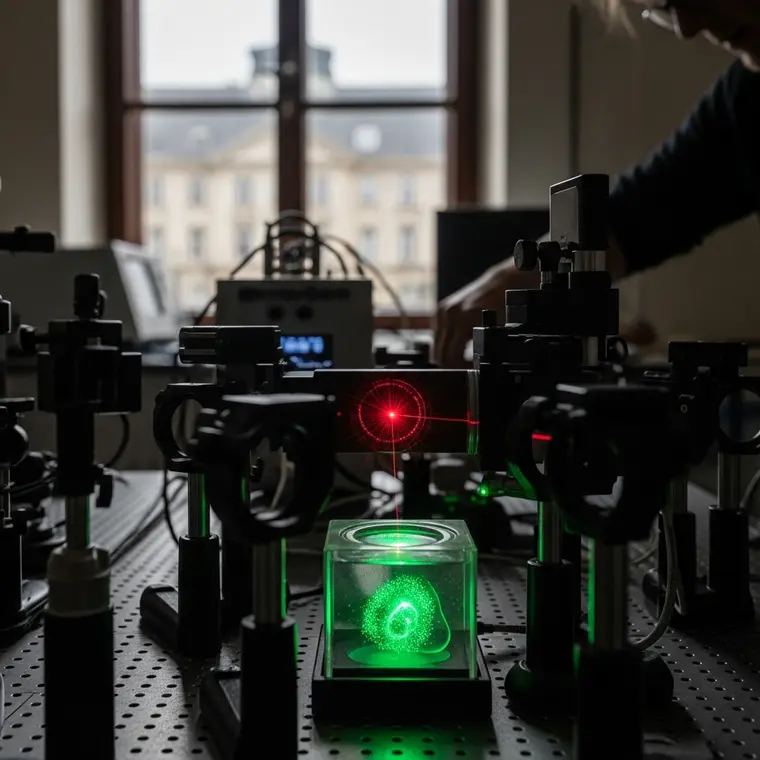
Jena, June 15, 2026 – Friedrich-Schiller-Universität Jena has recorded a significant scientific success: With Corinna Kufner, a renowned physicist from Harvard University has been recruited for the city on the Saale. As a new professor, she is now researching the emergence of the first biomolecules on the early Earth.
- Who: Prof. Dr. Corinna Kufner (Physicist)
- What: Research on the origin of life (Photonic Abiogenesis)
- Where: Friedrich-Schiller-Universität Jena & Leibniz-Institut für Photonische Technologien (Leibniz-IPHT)
- Method: Ultrafast spectroscopy using UV radiation
From Harvard to the Saale: A Win for Jena
The move from the US elite university Harvard to Jena at the end of 2024 is a remarkable success for the local scientific hub. It underscores the enormous international appeal of the Thuringian research landscape. After successfully leading the junior research group “Photonic Abiogenesis” since 2025, Kufner has held the professorship of the same name at Friedrich-Schiller-Universität since April 2026. The close cooperation between the university and the Leibniz-Institut für Photonische Technologien (Leibniz-IPHT) offered the scientist optimal conditions for establishing her research group.
What is Abiogenesis? On the Trail of Origins
Corinna Kufner’s research field is dedicated to one of humanity’s most fundamental questions: How did life begin? The technical term “abiogenesis” describes exactly this process – the emergence of living organisms from inanimate chemical building blocks. Kufner’s team specifically investigates the role played by the sun’s high-energy UV light on the inanimate early Earth. It is suspected that the radiation triggered crucial chemical reactions from which the first biological building blocks eventually emerged.
Filming Molecules with a “Slow-Motion Camera”
Since these chemical processes occur extremely quickly, the Jena research team utilizes a state-of-the-art method: ultrafast spectroscopy. For laypeople, this physical process can be imagined as an extremely high-resolution slow-motion camera. Through ultrashort laser pulses in the femtosecond range (billionths of a millionth of a second), researchers can observe the movement and change of atoms and molecules almost in real-time. This allows for precise analysis of how UV light changes the structure of matter and rearranges chemical bonds.
The findings from this fundamental physical research in Jena have far-reaching significance. They not only help to understand how life on Earth began but also provide important indicators for astrobiology in the search for organic traces on distant planets. Furthermore, the developed methods could influence future applications in medicine and space travel.
🏛️ The University of Jena as a Beacon of Optics and Photonics
The study of light has a long tradition in Jena, closely linked to the pioneers Carl Zeiss, Ernst Abbe, and Otto Schott. Today, the city on the Saale is one of the world’s leading centers for optics and photonics. Through the close networking of Friedrich-Schiller-Universität with top non-university institutes such as the Leibniz-IPHT, the location continuously succeeds in attracting high-profile international research groups. The new professorship builds a bridge between physics, chemistry, and biology and solidifies Jena’s leading role in the global scientific community.
Source:
Jena researcher investigates the origin of life
Transparency Note: This article was automatically created, editorially reviewed, and expanded with AI support.