
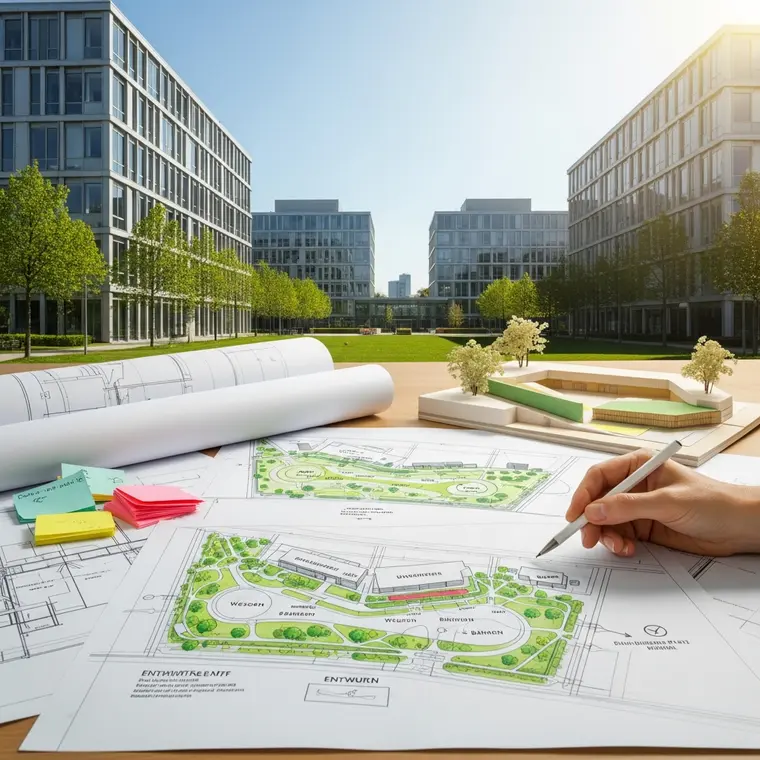
Jena, June 16, 2026 – The redesign of Ernst-Abbe-Platz is entering its next phase: The city of Jena invites all citizens to actively participate in shaping the city’s central meeting point. During a second participation workshop, the winning design from the landscape architecture competition will be presented and further developed together.
- What: 2nd Participation Workshop for the redesign of Ernst-Abbe-Platz
- When: Monday, June 22, 2026, starting at 5:00 PM
- Where: Hörsaal 4, Friedrich-Schiller-Universität Jena, Ernst-Abbe-Platz, 07743 Jena
- Admission: Free of charge, no prior registration required
- Motto: “More beautiful? Greener? More usable?”
A Central Meeting Point in Transition
Ernst-Abbe-Platz is the pulsing heart of the Jena university campus. Every day, thousands of students, residents, commuters, and customers of the adjacent shopping centers use the open space as a passage or meeting point. However, the current appearance of the square has long been subject to criticism: large, sealed concrete surfaces lead to significant heat buildup, especially during the hot summer months, while there is a simultaneous lack of sufficient shade, seating, and usable vegetation. A redesign is intended to remedy these deficits and adapt the square to the requirements of climate change.
From Competition to Citizen Participation
To find the best possible solution for this urban planning challenge, an open planning competition was announced. The design by the renowned planning office Atelier LOIDL emerged as the winner. This design now serves as the basis for the further process. However, the concept is not to be realized behind closed doors. Instead, the city of Jena is relying on a multi-stage participation process to allow the real wishes and needs of the local people to flow directly into the detailed planning. The upcoming workshop marks a decisive step in aligning the theoretical design with the practical everyday experience of the people of Jena.
The Core Goals: Greening, Usability, and Climate Adaptation
The guiding questions of the workshop – “More beautiful? Greener? More usable?” – reflect the essential objectives formulated by Atelier LOIDL in its design. The core goals of the redesign include:
- Comprehensive Greening: Creation of shade-providing tree and plant islands that noticeably improve the microclimate.
- Increased Quality of Stay: Integration of flexible and barrier-free seating and lounging options for all age groups.
- Multifunctional Usability: Ensuring that the square can continue to be used flexibly for university events, markets, or cultural events in the future.
- Climate Resilience: Use of innovative concepts for rainwater infiltration and utilization on-site (Sponge City principle).
Citizen Feedback On-Site and Online
On Monday, June 22, 2026, all interested parties will have the opportunity to receive first-hand information about the plans in Hörsaal 4 of the Friedrich-Schiller-Universität Jena. Representatives of the city administration and the planning office will present the winning design in detail. Subsequently, participants can formulate their criticism, suggestions, and concrete design ideas directly at various stations.
For all citizens unable to attend this date, the city of Jena is providing a digital alternative. Starting in late July 2026, the results of the workshop and the further developed planning documents will be published on the city’s central participation portal at mitmachen.jena.de. There, it will be possible to view, comment on, and evaluate the proposals online.
🏛️ The Significance of Ernst-Abbe-Platz
Ernst-Abbe-Platz is named after the physicist, social reformer, and Zeiss supporter Ernst Abbe and bears direct witness to Jena’s industrial heritage. Created during the revitalization of the former Zeiss main plant (Hauptwerk A), it marks the transition from historical factory architecture to a modern, open knowledge society. Today, it not only connects the university institutes and the lecture hall building but also serves as a link to the inner-city shopping district. Through the redesign, this historically and socially significant space is to be rebuilt to be future-proof and livable.
Source:
Citizens to help shape Ernst-Abbe-Platz
Transparency Note: This article was created automatically, editorially reviewed, and expanded with AI support.