
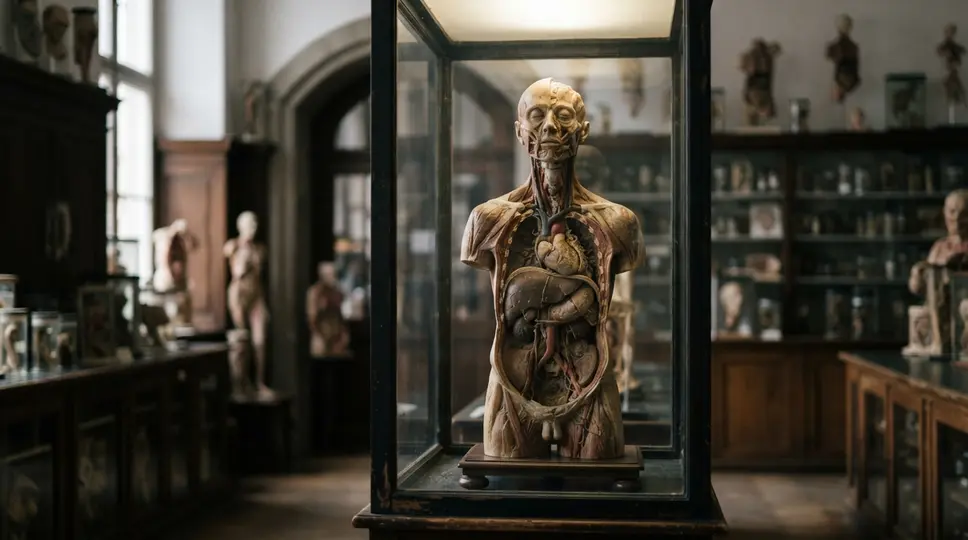
Jena, July 25, 2026: The Friedrich Schiller University Jena offers fascinating insights into the human body through its permanent exhibition at the Institute of Anatomy. The historical collection spans over 200 years, combining science with cultural history.
- Venue: Institute of Anatomy (FSU Jena), Teichgraben 7, 07743 Jena
- Regular opening hours: Wednesdays 2:00 PM – 5:00 PM and Saturdays 10:00 AM – 1:00 PM
- Admission: Free
- Note: Children under 12 must be accompanied by an adult
- Contact: Tel. 03641 9-396110 | Web: www.uniklinikum-jena.de
200 Years of Scientific History and Goethe’s Specimens
The Anatomical Collection of the University of Jena is among the oldest and most significant of its kind in Germany. Visitors can view artistic specimens and clear models that explain the structure and functions of the human organism. A major highlight of the exhibition is the historical intermaxillary bone specimens by Johann Wolfgang von Goethe, with which the poet and naturalist proved the existence of the intermaxillary bone in humans at the end of the 18th century.
Beyond its significance in the history of science, the exhibition calls for a sense of piety. As the premises display original body parts and exhibits of deceased individuals, all visitors are expected to behave in an appropriate and respectful manner. Furthermore, children up to and including the age of 12 must be accompanied by an adult.
Those interested in the evolution of the animal kingdom in addition to human anatomy will find another exciting educational opportunity in Jena with the family holiday tours at the Phyletic Museum.
Visitor Information and Dates
The permanent exhibition has established itself as a popular educational destination and indoor activity. Regular time slots are available for visitors:
- Saturdays: 10:00 AM to 1:00 PM (e.g., July 25, August 1, and August 8, 2026)
- Wednesdays: 2:00 PM to 5:00 PM (e.g., July 29, August 5, and August 12, 2026)
- Cost: Admission to the entire exhibition is free.
Background: Goethe’s Discovery in Jena
Johann Wolfgang von Goethe was not only a world-renowned poet but also a passionate naturalist. In 1784, he discovered the human intermaxillary bone (os incisivum) at the anatomical theater in Jena. Until then, it was assumed that this bone existed only in animals. Goethe’s discovery was considered an important building block for comparative anatomy and demonstrated the close relationship between humans and animals long before Charles Darwin’s theory of evolution.
Source:
Anatomical Collection Jena – Permanent Exhibition
Transparency note: This article was created automatically, editorially reviewed, and expanded with AI assistance.