
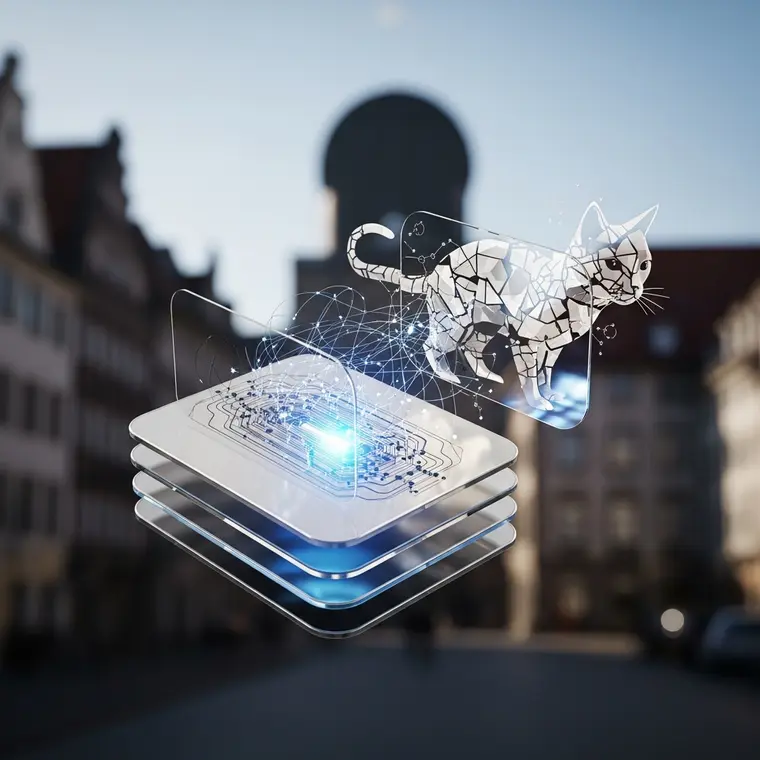
Jena, 30.04.2026. Friedrich-Schiller-Universität Jena and the Ernst-Abbe-Stiftung are continuing their renowned scientific lecture series. At the 80th Ernst-Abbe-Kolloquium next Monday, the technological future will be the focus of quantum mechanics.
- What: 80th Ernst-Abbe-Kolloquium on the topic „Of Cats, Quanta, and Computers“
- When: Monday, May 4, 2026, 5:00 PM
- Where: Physik-Hörsaal, Max-Wien-Platz 1, Jena
- Speaker: Physicist Prof. Dr. Jens Eisert
The Path into a New Era of Technology
The event highlights current developments in quantum physics and contextualizes their significance for future technologies. Under the descriptive title “Of Cats, Quanta, and Computers” – a direct reference to Schrödinger’s cat, the famous physical thought experiment – the speaker Prof. Dr. Jens Eisert bridges the gap from theoretical foundations to practical application.
The lecture focuses on new approaches in the field of quantum computing. This technology promises to achieve computing power that conventional high-performance computers have so far failed to reach. In the near future, highly complex problems in materials research, cryptography, or medicine could be solved in a fraction of the time previously required.
Background: Jena as a Physics Hub and the Colloquium
The Ernst-Abbe-Kolloquium is a long-standing institution of science communication in Jena. Named after the physicist, optician, and social reformer Ernst Abbe, the lecture series has served for decades as a platform for exchange on groundbreaking developments in the natural sciences.
The venue at Max-Wien-Platz is historically significant: it commemorates the physicist Max Wien (1866–1938), who, as director of the Physical Institute in Jena, played a key role in the research of high-frequency oscillations. Today, the campus at Max-Wien-Platz forms a central heart of the Faculty of Physics and Astronomy at Friedrich-Schiller-Universität and combines teaching and top-level research in the science location of Thuringia.
To understand the scope of the topic: unlike classical computers, which process information sequentially using bits (0 or 1), quantum computers use so-called qubits. Through quantum mechanical phenomena such as superposition and quantum entanglement, these qubits can assume multiple states simultaneously, enabling unprecedented parallel data processing.
Source:
Of Cats, Quanta, and Computers
Transparency Note: This article was automatically generated, editorially reviewed, and expanded with AI support.