
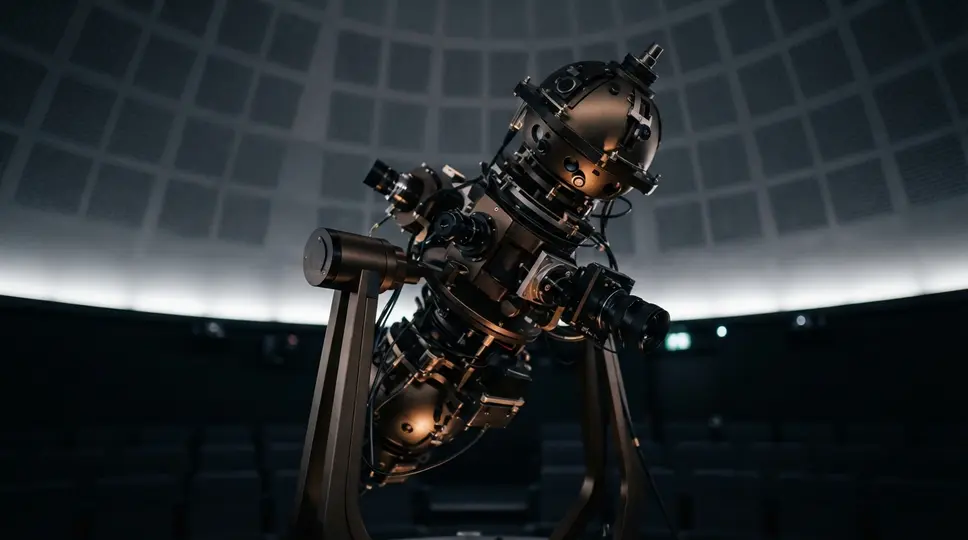
Jena, July 16, 2026 – The world’s oldest operating large planetarium, the ZEISS Planetarium Jena, reopens its doors just in time for its 100th anniversary following comprehensive technical modernization. Visitors can look forward to a state-of-the-art hybrid system featuring optical star projection and digital 8K dome cinema.
- What: Reopening of the modernized ZEISS Planetarium
- When: For the 100th anniversary on Saturday, July 18, 2026
- Where: ZEISS Planetarium Jena, Am Planetarium 5, 07743 Jena
- Technical Highlights: 8K resolution via 11 VELVET 4K projectors, 3D sound system, overhauled UNIVERSARIUM star projector
- Contact for inquiries: Phone: +49 151 42112288, E-mail: joachim.kuss@zeiss.com
The “Wonder of Jena” celebrates a century of technical history
The global success story of planetariums began in Thuringia. Even before the very first star projector amazed audiences at the Deutsches Museum in Munich in 1924, a provisional test installation on the roof of the ZEISS factory in Jena attracted more than 80,000 people. The technology was developed by Walther Bauersfeld. Consequently, Jena was one of the first cities in the world to build its own permanent planetarium structure.
In addition to the projection technology, the building itself is an engineering masterpiece. For the Jena planetarium, Bauersfeld developed an extremely light, thin shell-construction dome made of reinforced concrete. This revolutionary construction method enabled self-supporting, spherical halls and continues to influence the architecture of domed buildings worldwide to this day.
Technical Revolution: Hybrid System and 8K Resolution
The heart of the modernization is the newly installed, world-leading hybrid system. It combines the precise, optomechanical projection of the classic starry sky with state-of-the-art digital image display:
- The Star Projector: The ZEISS UNIVERSARIUM type projector, in use since 1996, was completely overhauled by experts from the ZEISS planetarium division. In addition to intensive cleaning and maintenance of all optical, mechanical, and electrical components, new star plates were installed and the planet projectors were converted to energy-efficient, brilliant LED lighting.
- The Digital Projection System: Eleven newly installed VELVET 4K projectors from ZEISS cast a razor-sharp image onto the dome, reaching a total resolution of 8K. Thanks to an extreme contrast ratio of 1:5,000,000, the projectors create an absolutely deep black. This allows the stars to stand out from the background with maximum luminosity and brilliance.
Unique 3D Sound for Immersive Experiences
In addition to the visual renewal, the acoustics in the dome hall have been fundamentally upgraded. A 3D sound system, unique in Europe, has been installed, making the shows acoustically immersive. Dr. Nicole Nelles, Head of ZEISS Planetariums, emphasizes the importance of the location: “The Jena ZEISS Planetarium is the oldest operating planetarium in the world and a highlight of technical history. Following the modernization work, it now features one of the most innovative planetarium systems worldwide.”
With these forward-looking upgrades, the institution strengthens its role as a driver of innovation. In addition to scientific lectures and educational offerings, the planetarium also provides space for modern art and entertainment formats. A well-known example of this diversity is the FullDome Festival at the Planetarium Jena, which is known far beyond the city limits and attracts national and international artists.
🏛️ History & Building: The Invention of the Zeiss-Dywidag Shell Construction
The Jena planetarium is a world-class monument not only because of its projection technology but also because of its architecture. To span the huge dome with a diameter of 23 meters in a self-supporting and cost-effective manner, ZEISS engineer Walther Bauersfeld developed a completely new construction method together with the construction company Dyckerhoff & Widmann (Dywidag). A fine network of rods was sprayed with a thin concrete shell only six centimeters thick.
This so-called “Zeiss-Dywidag shell construction” is considered the birth of modern shell concrete construction. It was so stable and light that it inspired architects worldwide and made the construction of modern sports stadiums, train station halls, and opera houses in the 20th century possible in the first place.
Source:
Brilliant stars, bright planets, and spectacular galaxies
Transparency note: This article was created automatically, editorially reviewed, and expanded with AI support.