
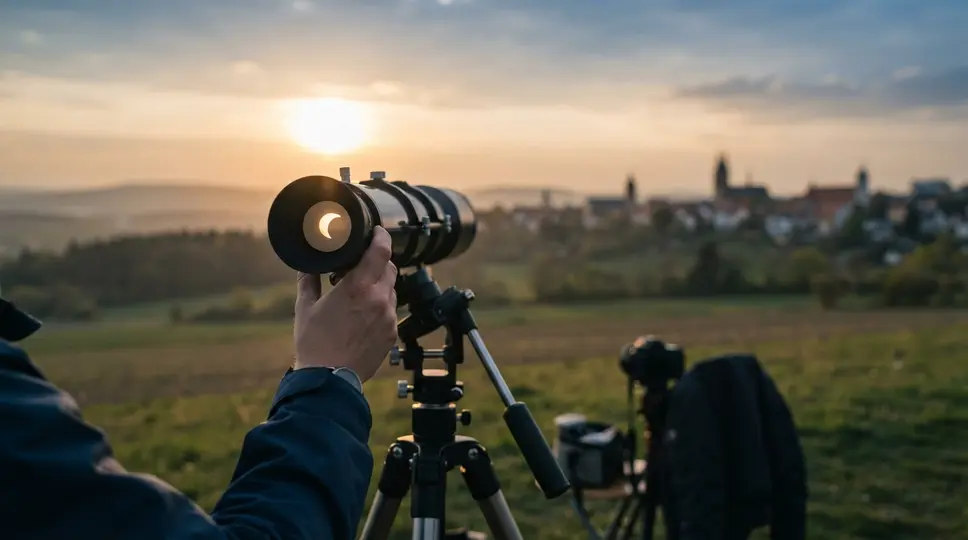
The skies over Thuringia are set to host a spectacular celestial event: On the morning of August 2, 2027, the moon will pass in front of the sun, producing a striking partial solar eclipse in Jena. Around 40 percent of the solar disk will be covered around midday.
- Event: Partial Solar Eclipse 2027 (Magnitude 0.50)
- Date: Monday, August 2, 2027
- Start in Jena: 10:12 AM CEST (First Contact)
- Maximum in Jena: 11:11 AM CEST (Maximum Coverage: 40.4%)
- End in Jena: 12:12 PM CEST (Last Contact)
- Sun Position: Approx. 53° high in the south (perfectly visible above rooftops & hills)
- Recommended Viewpoints: Landgrafen, Jenzig, Windknollen & the Urania Public Observatory
Following the tremendous interest in the solar eclipse in Jena on August 12, the next major astronomical highlight arrives on August 2, 2027. While observers in Southern Europe, North Africa, and Egypt will experience a total “Eclipse of the Century”, the sun over Thuringia will transform into a distinctive crescent.
Exact Timeline of the 2027 Solar Eclipse in Jena
The eclipse begins in Jena at exactly 10:12 AM CEST. At this moment, the new moon first touches the upper edge of the sun (1st contact). Over the following hour, the moon gradually glides across our host star.
The peak is reached at 11:11 AM CEST: Exactly 40.37 percent of the sun’s surface will be obscured by the moon’s shadow (Magnitude 0.504). During this phase, the landscape is bathed in a distinctively muted, silvery daylight. The moon then moves on until 12:12 PM CEST, when the full solar disk is completely restored.
| Phase | Time (CEST) | Sun Altitude & Direction | Appearance |
|---|---|---|---|
| 1st Contact (Start) | 10:12 AM | approx. 46° / Southeast | First small notch on the solar rim |
| Maximum (Peak) | 11:11 AM | approx. 53° / South-Southeast | Over 40% of the sun obscured |
| Last Contact (End) | 12:12 PM | approx. 57° / South | Sun disk fully round again |
Best Viewing Spots in Jena: Clear Line of Sight to the South
Unlike evening eclipses, the sun on August 2, 2027, will stand very high in the sky around noon (more than 50 degrees altitude). As a result, buildings in the Saale Valley will rarely obstruct the view. Nonetheless, Jena’s elevated spots offer the best observation and nature experience:
- Landgrafen & Balcony of Jena: Excellent panoramic views over the city with completely unobstructed sightlines to the south.
- Jenzig (Jenzighaus & Summit Plateau): Thanks to its exposed location, you enjoy a direct, obstacle-free line of sight toward the south-southeast.
- Windknollen: The extensive nature reserve on the plateau provides a 360-degree panorama, making it an ideal open-air vantage point.
- Fuchsturm & Hausberg: Popular viewpoint with shaded resting areas and an ideal sun angle.
- Paradies Park & Rasenmühleninsel: Down in the valley, the expansive lawns offer plenty of space to observe the high midday sun comfortably.
- Urania Public Observatory & Zeiss Planetarium: Historically, the astronomers at the planetarium and the Urania Jena organize guided viewing sessions with specialized solar telescopes during such events.
Eye Protection Is Mandatory: Prevent Irreversible Retinal Damage
Crucial Safety Warning: Never look directly at the sun with the naked eye, standard sunglasses, smoked glass, CDs, or emergency space blankets! Even with 40 percent of the sun covered, the remaining sunlight is intense enough to cause painless, permanent retinal burns (solar retinopathy) within a fraction of a second. The retina has no pain receptors—damage leading to partial or total blindness is often only noticed hours later.
For direct solar observation, only certified eclipse glasses complying with the DIN EN ISO 12312-2:2015-11 standard are safe. These specialized filters block over 99.999 percent of visible light as well as dangerous ultraviolet and infrared radiation.
⭐⭐⭐⭐⭐ 4.9 / 5
Certified Solar Eclipse Glasses (ISO 12312-2)
Historically, certified eclipse glasses sell out completely weeks before the event. Make sure to secure verified eye protection for your family well in advance.
How to Build a DIY Pinhole Camera: 3 Easy Methods
If you do not have certified glasses at hand or want to safely demonstrate the eclipse to children, you can project the phenomenon using the Camera Obscura (pinhole projector) principle onto a white surface. Here are the three easiest DIY builds:
1. The Classic Shoebox Projector (Best Image Quality)
A simple shoebox can be turned into a sturdy observation box in under five minutes:
- Projection Screen: Tape a piece of white paper to the inside of one of the short ends of the shoebox.
- Cut Openings: On the opposite short end, cut two small windows—a 2×2 cm window on the left for the pinhole and a 3×3 cm viewing hole on the right for your eye.
- Pinhole Aperture: Tape a piece of aluminum foil over the projection window and gently poke a tiny, clean pinhole through it using a pin or needle.
- Observation: Close the shoebox tightly with its lid. Stand with your back to the sun, align the foil pinhole toward the sun, and look through the viewing hole at the white paper. You will see a sharp, miniature projected image of the crescent sun!
2. The Compact Pringles Can Tube
A compact, pocket-friendly pinhole viewer for on the go:
- Cut an empty chips can or mailing tube cleanly all the way around, about 6 cm above the metal base.
- Poke a small, neat hole right into the center of the metal base using a pin.
- Stretch a piece of baking parchment or tracing paper tightly over the open cut edge of the longer tube section as a screen, and tape it securely.
- Reassemble the two parts together and wrap dark adhesive tape around the seam to seal out light.
- Look through the top open end onto the parchment screen: The image of the sun will be projected directly onto the screen inside.
3. The 2-Card Quick Method & Kitchen Colander Trick
When time is short: Take two white sheets of cardstock. Poke a small pinhole in the center of the first card. Hold this card up so sunlight passes through the hole, casting its shadow onto the second card held below. The further apart you hold the cards, the larger the projected solar image becomes.
Genius Photo Tip: During the peak of the eclipse, hold a common kitchen colander into the sunlight. Every single hole in the colander acts as an individual pinhole projector, casting a stunning pattern of dozens of miniature solar crescents onto the ground!
⭐⭐⭐⭐⭐ 4.8 / 5
Solar Filter Sheets for Cameras, Binoculars & Telescopes
Anyone planning to photograph or observe the eclipse through telephoto lenses or binoculars must use front-mounted solar filter foil to protect camera sensors and eyesight.
Background: The “Eclipse of the Century” of 2027
The solar eclipse of August 2, 2027, belongs to the renowned Saros Series 136 and ranks among the longest total eclipses of the 21st century. While the moon’s umbral shadow sweeps over the Strait of Gibraltar, southern Spain, Algeria, and Egypt—plunging Luxor into sensational darkness for 6 minutes and 22 seconds—Central Europe will experience the penumbra. For Jena, this brings one of the most impressive partial solar eclipses of the decade, perfectly timed during the bright late morning hours.
Transparency Notice: This article was independently researched, editorially reviewed, and produced with the assistance of AI.