
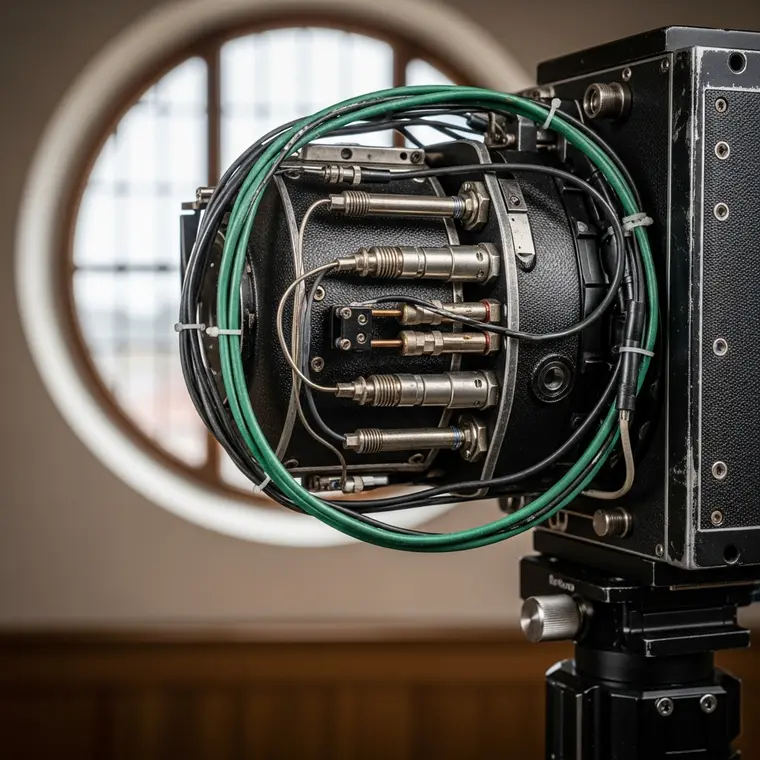
Jena, June 20, 2026 – The exploration of outer space is inextricably linked with precision technology from Jena: In September 1976, the MKF-6 multispectral camera from Carl Zeiss wrote space history aboard the Soviet Sojus-22 mission.
- Object: MKF-6 multispectral camera
- Manufacturer: VEB Carl Zeiss Jena
- First use: September 1976 (Sojus-22 mission)
- Technical data: Six lenses, simultaneous exposure with less than 2 ms deviation, resolution of 10 to 20 meters from an altitude of 355 km
- Fields of use: Geology, cartography, environmental monitoring, and military reconnaissance
A Milestone of Space Research from Thüringen
When we think of space exploration today, we usually think of the major launch sites in Kasachstan or the USA. Yet a decisive eye that enabled the view from the cosmos back to Earth was manufactured in the heart of Thüringen. Almost exactly fifty years ago, in September 1976, the MKF-6 multispectral camera flew into space aboard the Soviet spacecraft Sojus 22. This technological masterpiece was developed and built at VEB Carl Zeiss Jena. In doing so, the engineers, designers, and precision mechanics from Jena built directly upon the city’s decades-old optical tradition, which had been established by pioneers such as Carl Zeiss, Ernst Abbe, and Otto Schott. With this milestone, Jena finally became a center of international space history.
The Technical Achievement of the MKF-6
The requirements for the developers in the Jena workshops were extremely high. From an orbit of around 355 kilometers in altitude, the camera was expected to deliver razor-sharp images of the Earth’s surface. However, the MKF-6 was no ordinary photo camera. It featured six lenses arranged in parallel, which captured the same section of the Earth simultaneously. The highlight of this system: each lens operated in a different spectral range – four in visible light and two in the invisible near-infrared range.
This multispectral technology made it possible to visualize details that would otherwise remain hidden to the human eye. Geologists identified rock structures, agricultural scientists could analyze the condition of crops, and cartographers drew more precise maps than ever before. The optical masterpiece was complemented by incredible mechanical precision. All six shutters had to trigger almost absolutely synchronously – the permissible deviation was less than two milliseconds. Any delay, however tiny, would have rendered the subsequent overlay of the images useless.
Between Science and Military Secrecy
Due to its outstanding image quality – objects only ten to twenty meters in size could be identified in the photographs – the MKF-6 immediately piqued the interest of strategic planners. The Soviet Union immediately classified the camera as militarily sensitive technology of the highest level of secrecy. Export outside the states of the Warsaw Pact was strictly prohibited.
At the same time, the camera performed pioneering work in the civilian sector. It laid the foundation for modern environmental monitoring from space. Later, modified versions of the MKF-6 were used on the space stations Saljut 6 and Saljut 7, as well as on the legendary space station Mir. For decades, Jena optics thus remained the standard for Earth observation in the socialist space program.
The Legacy of Carl Zeiss Jena in the Cosmos
Today, the MKF-6 stands as a symbol of an era in which Jena’s top-tier achievements shaped the world stage – and outer space. While the general public often thinks of microscopes, binoculars, or eyeglass lenses when they hear the name Carl Zeiss, the history of the space camera shows how profoundly the technological know-how of the Saalestadt has shaped modern research. The processes developed in Jena for lens coating, precision mechanics, and spectral image analysis continue to influence modern satellite technology today.
🏛️ History & Buildings: The Cradle of Modern Optics
The development of the MKF-6 in the 1970s would have been unthinkable without the historical foundation of Jena’s industry and science. As early as 1846, Carl Zeiss opened his first workshop for precision mechanics and optics in Jena. However, the decisive scientific turning point was brought about by the collaboration with physicist Ernst Abbe from 1866, who placed microscope manufacturing on an exact mathematical basis, and chemist Otto Schott, who revolutionized glass chemistry. This trio made Jena a world city of optics. The resulting companies, above all the Zeiss-Werk and the Jenaer Glaswerk, not only shaped the cityscape through monumental industrial buildings such as the world-famous Volkshaus or the historical Bau 15 – the first German skyscraper – but also created a unique research landscape that lives on today at the Friedrich-Schiller-Universität and numerous institutes.
Source:
The view from space came from Jena – Cool’is in the East
Transparency Note: This article was automatically generated, editorially reviewed, and expanded with AI support.