
Jena, July 14, 2026. After a modernization phase lasting approximately six months, the world’s oldest large-scale planetarium in Jena is reopening its doors to visitors. Just in time for its 100th anniversary, the traditional facility has been extensively renovated and equipped with forward-looking image and sound technology.
- Event: Reopening of the Zeiss-Planetarium Jena after modernization
- Date of reopening: Wednesday, July 15, 2026
- Occasion: 100th anniversary of the planetarium
- Highlights: New 8K dome projection, Holoplot audio system, 20th Fulldome Festival
- Location: Am Planetarium 15, 07743 Jena
Comprehensive modernization for the 100th anniversary
After the planetarium remained completely closed for half a year since the beginning of 2026, the historic building now shines in new splendor. The last minor renovation took place in 2017, but the current work went much deeper. As planetarium director Stefan Harnisch explained, the star theater was “completely touched from the floor to the sky.”
The measures were by no means limited to cosmetic repairs. The entire building services, including heating, air conditioning, and ventilation, were fundamentally renewed to sustainably increase visitor comfort. The attached restaurant was also renovated during the work. However, the absolute focus was on a profound renewal of the projection surface as well as the entire image and sound technology.
Technical innovations in image and sound
The most important visual innovation concerns the projection dome. The old screen was completely removed down to the outer shell of the dome. During this process, the historic geodesic rod network from 1926 was briefly visible. The new, approximately nine-ton projection surface consists of special panels whose transitions are no longer perceptible to the human eye. Together with four tons of new insulation, this construction ensures a completely seamless image.
The installed technology also sets new standards:
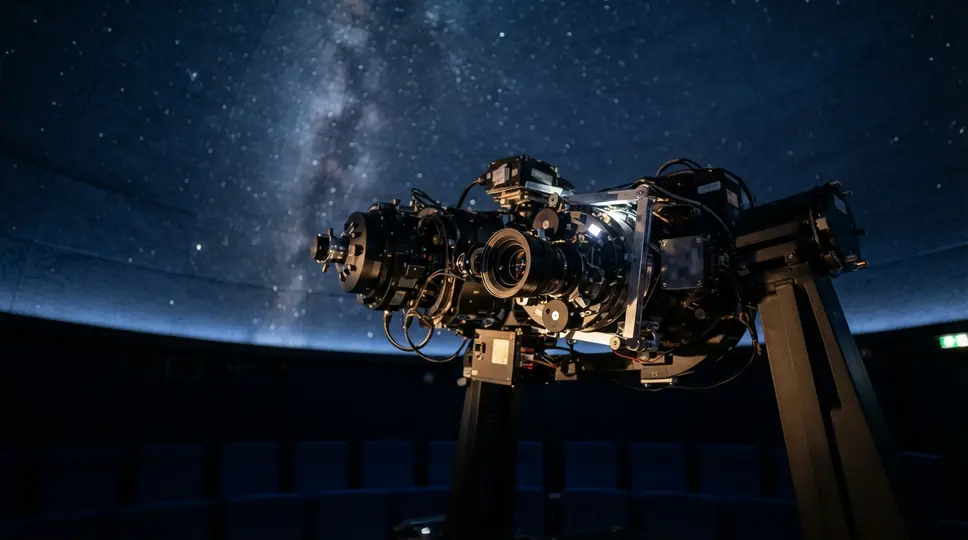
- 8K dome projection: A total of eleven high-resolution 4K projectors from Zeiss were installed. They create a joint dome image in 8K resolution. This technology is being used in this form in a planetarium for the first time worldwide.
- Revolutionary sound technology: A new audio system from the manufacturer Holoplot was installed behind the dome. This technology, which is used in the famous “Sphere” event arena in Las Vegas, among others, works with well over 1,000 loudspeakers.
- Targeted sound wave control: Through wave field synthesis, the sound can be precisely controlled. This will make it possible in the future to play the program to different seating blocks in different languages without mutual acoustic interference.
The world-famous star projector in the center of the room has been preserved and now works hand-in-hand with the new digital technology to create an incomparably immersive space experience.
Dates for the reopening and Fulldome Festival
The official start for public operations is Wednesday, July 15, 2026. The reopening is closely linked to one of the most important events in the international planetarium scene:
- July 15 to 17, 2026: The 20th Fulldome Festival will take place in the modernized hall. International 360-degree films and immersive artworks will be shown. In the evenings, there will be top-class live events, including a performance by the well-known DJ Oliver Koletzki.
- July 18, 2026 (Saturday): Official ceremony for invited guests exactly 100 years after the first opening in 1926.
- From July 19, 2026 (Sunday): Start of regular operations for all visitors. The program for the second half of the year has already been published.
As a special souvenir for the anniversary, an exclusive special construction kit of the Thuringian Ankerbausteine is being released, with which fans can faithfully recreate the striking building in miniature format. Those interested in the background of the renovation can find further details on the structural challenges in the report on the Zeiss-Planetarium after the renovation.
🏛️ History & Significance: The nucleus of the optical industry
The Zeiss-Planetarium in Jena is considered the oldest large-scale planetarium in the world. Opened on July 18, 1926, the building looks back on a rich history. The optical technology behind the star projection was developed starting in 1923 by the Carl Zeiss company on behalf of the Deutsches Museum and brought to market maturity at the Jena headquarters. Jena thus definitively established itself as the global center of the optical and precision engineering industry. To this day, the planetarium is not only a major tourist attraction in Thuringia but also a monument to the history of science and technology.
Source:
Den Sternen so nah: Das ist neu im Zeiss-Planetarium
Transparency note: This article was created automatically, editorially reviewed, and expanded with AI support.