
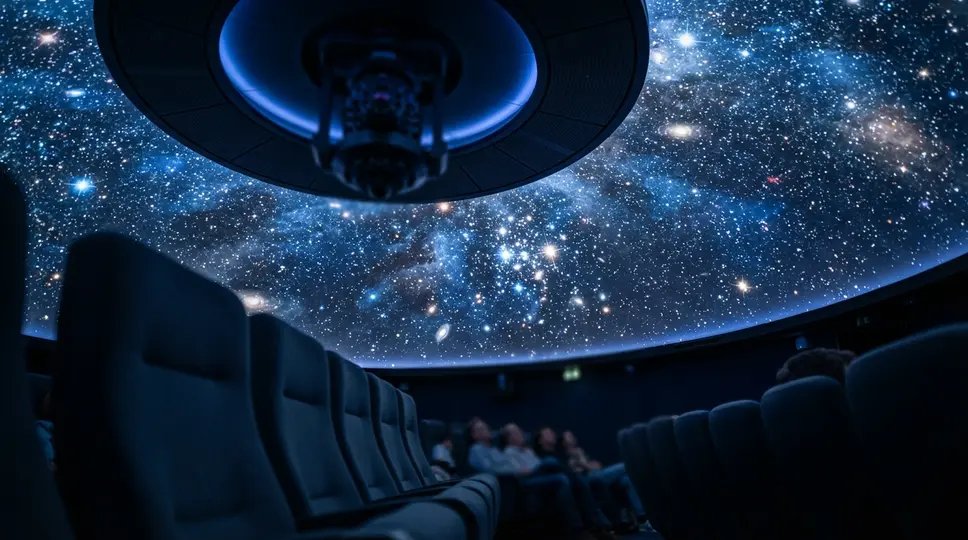
Jena, July 15, 2026 – Just in time for its 100th anniversary, the world’s oldest large-scale planetarium enters a new era: following extensive renovations, the Zeiss-Planetarium Jena is reopening its doors. Visitors can look forward to a globally unique combination of state-of-the-art projection technology and groundbreaking acoustics.
- Event: Reopening of the Zeiss-Planetarium after modernization
- Date: Start of regular operations on Sunday, July 19, 2026
- Location: Am Planetarium 5, 07743 Jena (View on Google Maps)
- Technical Highlights: New ZEISS 4K projection, immersive HOLOPLOT sound
Technical revolution under the dome: Sharper stars in 4K
At the heart of the extensive modernization is a completely renewed projection system. The newly installed 4K projection system from Carl Zeiss delivers four times the resolution of the previous Full HD system with more than eight million pixels. For visitors, this means a drastic visual improvement: stars in the artificial sky appear sharper, colors are more vibrant, and scientific visualizations of cosmic structures are depicted in great detail. According to the operators, this specific technology is being used in this form in a planetarium for the first time worldwide in Jena.
At the same time, the dome’s projection surface was fundamentally overhauled. Through the use of special, seamless transitions, the previous “igloo effect,” where individual segments of the dome structure were distractingly visible in bright images, is a thing of the past. The illusion of an infinite, flawless space is now nearly perfect.
Immersive sound from all directions
In addition to the visual innovations, the Jena planetarium is also setting new standards in acoustics. Instead of a classic channel-based surround sound, an immersive audio system from the Berlin-based specialist HOLOPLOT has been installed. This technology, known from the giant “Sphere” entertainment arena in Las Vegas, among others, is celebrating its worldwide premiere in a planetarium in Jena.
The system makes it possible to precisely control sound waves in three-dimensional space. Sounds can be projected specifically to certain positions, giving visitors the feeling that noises are moving directly over their heads or that a spaceship is launching in the middle of the hall. As a result, the modernized planetarium is no longer just suitable for astronomical educational programs, but increasingly for sophisticated concerts, readings, and live radio plays under studio conditions.
The 100th anniversary of a world premiere
The reopening falls exactly in the anniversary year of the historic institution. On July 18, 1926, the Zeiss-Planetarium Jena was ceremoniously opened to the general public for the first time. It has since been considered the cradle of modern planetarium technology. The fact that the Zeiss-Planetarium reopens after modernization exactly in time for this historic milestone marks another highlight in Jena’s city history. To mark the centenary, a limited edition special construction set of the traditional Thuringian Ankersteine is also being released, depicting the striking architecture of the Jena planetarium in miniature format.
Visitor Service: Start of regular operations
After the international Fulldome Festival already offered an exclusive preview of the new technology, regular public operations will begin this coming weekend. The following information applies to visitors:
- Regular operations: The official schedule resumes on Sunday, July 19, 2026.
- Program variety: In addition to astronomical shows such as journeys through the solar system, the program will increasingly feature fulldome films, music and science shows, and special family formats.
- Tickets and reservations: Due to high demand for the reopening, it is strongly recommended to purchase tickets online in advance.
- Arrival: The planetarium is located near the city center in the Damenviertel and is easily accessible on foot, by bicycle, or via local public transport tram stops.
🏛️ History & Building: The cradle of star domes
The Zeiss-Planetarium in Jena was built between 1924 and 1926 and is considered the oldest projection planetarium in the world. The striking dome with a diameter of 23 meters is based on a pioneering rod network construction developed by Walther Bauersfeld, an engineer at the Carl Zeiss company. This revolutionary lightweight construction, which later became world-famous as the geodesic dome, first made it possible to project the artificial starry sky onto a self-supporting interior surface. To this day, the historic dome structure defines the cityscape on the edge of Jena’s Damenviertel and attracts well over 150,000 visitors annually.
Source:
Jubilee under the stars: Zeiss-Planetarium opens for its 100th anniversary
Transparency note: This article was created automatically, editorially reviewed, and expanded with AI support.