
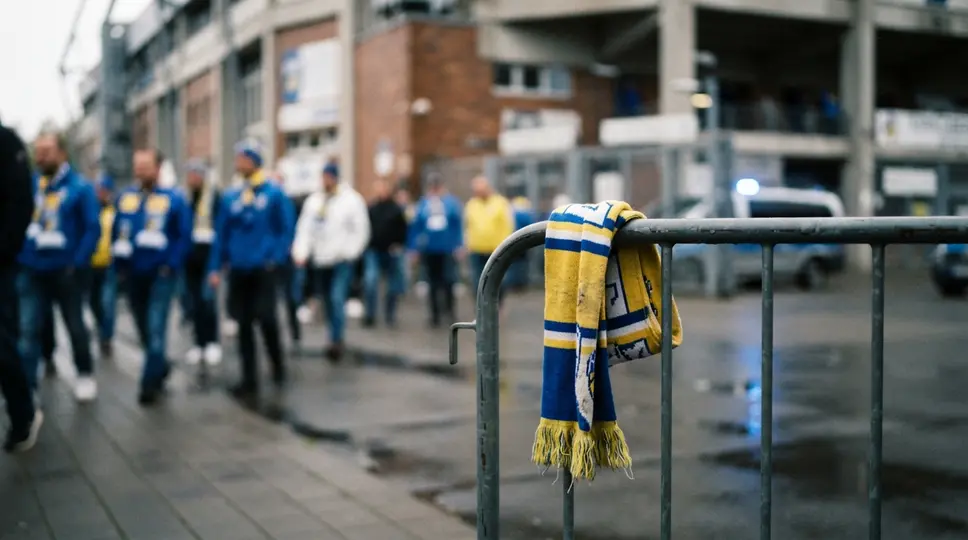
Jena, July 29, 2026: Exactly one year later, the stadium bans imposed by the city of Jena on 56 fans of FC Carl Zeiss Jena at the Ernst-Abbe-Sportfeld have expired. Although those affected are permitted to return to the Südkurve for the new season, the police operation at the time, the exercise of the city’s domiciliary rights, and future security requirements remain under criticism.
- Event: Expiration of 56 municipal stadium bans for the Ernst-Abbe-Sportfeld
- Occasion: Riots during the regional league match against BSG Chemie Leipzig on November 30, 2024
- Affected parties: Originally 61 bans issued (5 lifted early, 56 valid until July 24, 2026)
- Status Quo: Return of fans possible; clarification of the domiciliary rights issue between the city and the club is still pending
A turning point in the Südkurve: End of stadium bans
For a total of 56 supporters of FC Carl Zeiss Jena, the gates to the Ernst-Abbe-Sportfeld are opening again as preparations for the new season begin. For one year, they had been denied access to the home venue. The city of Jena had enforced the measures following incidents after the match against BSG Chemie Leipzig in late November 2024.
Of the 61 original stadium bans, the city administration lifted five over the course of the year due to changing investigative results. For the majority of the affected FCC fans, however, the decision meant the loss of their usual terrace for the entire past season. While the return to the block is being celebrated, the conflict continues to smolder in the background.
Criticism of police operations and the rule of law
The fan support group “Blau-Gelb-Weiße Hilfe e.V.” continues to criticize the lack of an independent investigation into the events behind the Südkurve. After the match, police forces had separated opposing fans following pyrotechnic incidents and clashes between fan groups. However, the subsequent operation has faced heavy criticism.
According to the Thuringian Ministry of the Interior, police used irritant spray 91 times, batons 105 times, and physical force 69 times during the operation. A total of 79 people were injured in the clashes, including ten police officers and five security guards. Fan representatives accuse the authorities of having escalated rather than de-escalated the situation through the massive use of pepper spray.
Furthermore, the instrument of municipal stadium bans is under scrutiny: because these were issued based on police suspicions rather than final court convictions, fan representatives see the legal principle of the presumption of innocence as being undermined.
Legal balance sheet and controversial investigative methods
The criminal investigation by the Gera public prosecutor’s office is still not concluded a year and a half after the events:
- Penalty orders: 38 applications filed; 23 penalty orders are legally binding, one case resulted in an acquittal.
- Indictments: Charges were brought against 19 people; of seven juvenile cases heard, only one ended in a conviction, six were dismissed.
- Dismissals: In nine cases, investigations were completely dropped due to a lack of evidence.
One case drew particular attention when the public prosecutor’s office had to withdraw an indictment following a morphological report. The accusation had previously relied on identification by a so-called “super-recognizer” – a method whose evidentiary value is viewed skeptically by legal experts and fan support groups.
Unresolved property rights and future requirements
Beyond the legal assessment, the case touches on fundamental questions of stadium management. FC Carl Zeiss Jena questioned whether the city of Jena was even authorized under the lease agreement to unilaterally issue stadium bans for match operations. The jurisdiction could not be conclusively clarified in court, which is why the club and the municipality began negotiations on adjusting the lease agreement. A binding agreement has not yet been reached.
Regardless of this, upcoming matches are casting their shadows. Security official Benjamin Koppe announced that for high-risk matches – such as the upcoming game against FC Rot-Weiß Erfurt – capacities for guest fans and high-risk areas may continue to be reduced by up to 50 percent. The debate regarding safety, proportionality, and fan rights at the Ernst-Abbe-Sportfeld will therefore continue to accompany the city in the new season.
Background: The Ernst-Abbe-Sportfeld and domiciliary rights
The Ernst-Abbe-Sportfeld in southern Jena has been the traditional home of FC Carl Zeiss Jena since 1924. Following comprehensive modernization into a football-only stadium, the security and operational structure has also changed. During match days, domiciliary rights exist in a field of tension between the club as the tenant and organizer and the city of Jena as the owner of the sports facility. Conflicts over stadium bans and security concepts regularly highlight the legal challenges in distinguishing between municipal hazard prevention and the club’s own responsibility as an organizer.
Source:
Return to the Südkurve: Stadium bans for fans in Jena end – debate remains
Transparency note: This article was created automatically, editorially reviewed, and expanded with AI support.