
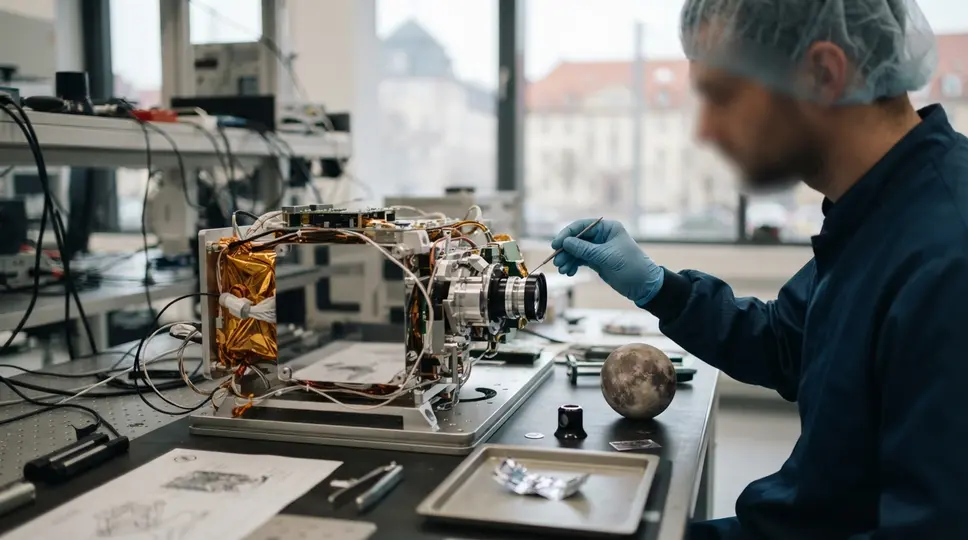
Jena, July 20, 2026. Progress in space exploration has a downside: the increasing accumulation of debris on the Moon and in its orbit. Research technology from Jena, installed in probes such as Athena, also contributes to the issue of remnants left on the Earth’s satellite after missions conclude.
- Topic: Space debris on the Moon
- Key point: Jena sensor technology as part of the debris problem
- Date: July 20, 2026
Challenge in Space
Whether unused experiments, crashed probes, or remnants of rocket stages: around 150 missions to the Moon have taken place since 1959. Experts from the European Space Agency’s (ESA) Space Debris Office point out that monitoring these small objects is extremely difficult due to a lack of observation capabilities. Since there is no atmosphere on the Moon to slow down debris, these objects pose a growing threat to future bases and missions.
🏛️ History & Technological Relevance
Jena looks back on a long tradition in high-precision optics and sensor technology, which is essential for modern space travel today. Local companies and research institutions provide key components for international space missions. The challenge now is to combine this high-tech with concepts for sustainable space management in order to keep the Moon habitable and usable as a scientific destination in the long term.
Approaches: From Problem to Resource
Scientists are already working on strategies to counter the flood of debris. For example, the ESA is planning missions to identify debris in lunar orbit using special telescopes. Furthermore, there are approaches to view materials not just as waste: researchers such as Prof. Dr. Carsten Drebenstedt from the TU Bergakademie Freiberg see potential in using old rocket structures directly for on-site construction. This principle of “unconditional recycling” could be the decisive step in making the future industrial development of the Moon sustainable.
Source:
Sensors from Jena as hazardous waste on the Moon
Transparency note: This article was created automatically, editorially reviewed, and expanded with AI support.