
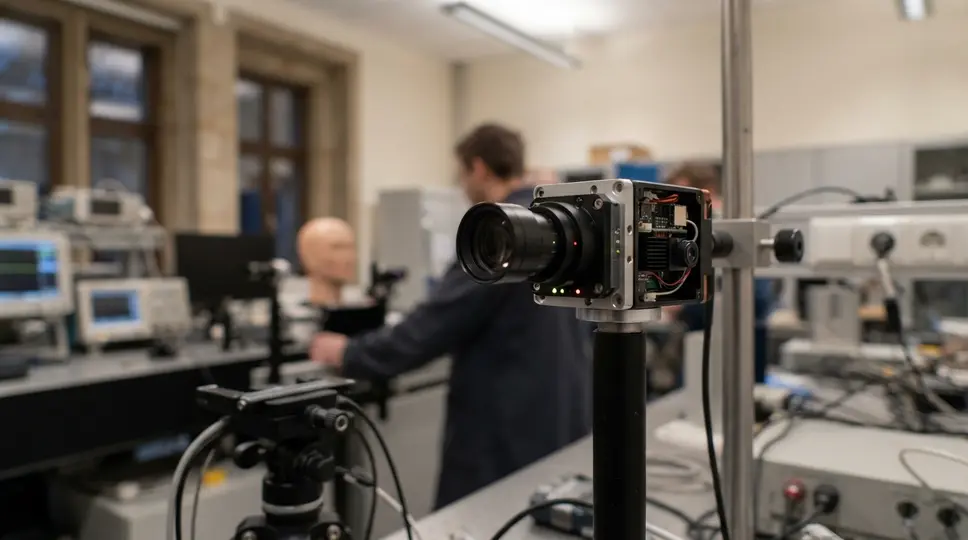
Jena, September 23, 2026 – Scientists at the Fraunhofer Institute for Applied Optics and Precision Engineering (IOF) in Jena have introduced a new optical system for the non-contact monitoring of bodily functions. The sensor, named “goVISCAN,” records heart rate, respiratory rate, and oxygen saturation from a distance of up to 1.3 meters.
- Technology: Multiscale camera with nine microlenses and LED illumination
- Measuring distance: 70 centimeters to 1.3 meters
- Development: Fraunhofer Institute for Applied Optics and Precision Engineering (IOF) Jena
- Next presentation: High-tech trade fair W3+ in Jena and VISION in Stuttgart
How the goVISCAN sensor works
The technical principle is based on minimal skin discolorations caused by blood flow with every heartbeat. While the human eye cannot perceive these movements, a highly sensitive multispectral camera registers the subtle changes. The core of the device, which measures only ten by 7.5 centimeters, is a fingernail-sized piece of glass with nine microlenses. Each lens acts as a separate objective for a specific light spectrum ranging from blue to near-infrared.
Through this multiple exposure and an integrated illumination unit consisting of light-emitting diodes, the sensor is designed to be significantly less susceptible to interference from ambient light or movement compared to older methods.
Current research status and laboratory tests
So far, the system has been tested in a controlled laboratory study with twelve subjects. Compared to standard finger sensors, the measured values deviated by an average of 1.3 breaths for respiratory rate and 2.8 beats per minute for heart rate. For oxygen saturation, the deviation was 3.8 percentage points, meaning the device has not yet fully reached the standard of approved medical pulse oximeters. Clinical testing is planned as the next step.
Potential everyday applications
In the long term, the developers see diverse application possibilities for medical technology as well as in everyday life. These include cable-free monitoring of patients in hospital beds, advanced telemedicine applications, the detection of fatigue in road traffic, and stress monitoring at PC workstations.
The sensor will be presented to the public for the first time this Wednesday at the high-tech trade fair W3+ in Jena. A presentation at the image processing trade fair VISION in Stuttgart will follow on October 6.
Background: The research alliance
goVISCAN was created as part of the regional “Advanced Multimodal Imaging” alliance, which involved the Jena-based Fraunhofer IOF, TU Ilmenau, and various medium-sized companies. The project ran from 2022 to 2025 and was funded by the Federal Ministry of Research with approximately nine million euros. In addition to medical sensors, the researchers also developed technologies for the sorting of plastic packaging and construction waste analysis.
Source:
Pulse, breathing, oxygen: Jena researchers measure vital signs from a distance of one meter
Transparency note: This article was created automatically, editorially reviewed, and expanded with AI support.