
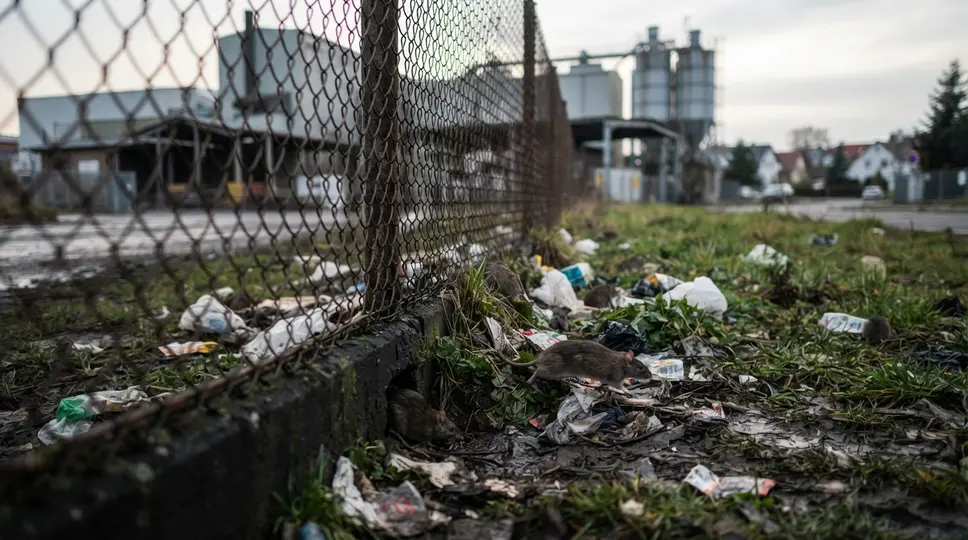
Jena-Löbstedt, July 8, 2026. Residents and allotment gardeners in the Jena district of Löbstedt are complaining about an increasing burden caused by wind-blown waste and an associated rat infestation, which is said to originate from the neighboring Veolia waste management facility. While local district politics are calling for structural enclosures, the company and the city administration point to already tightened protective measures.
- Location: Jena-Löbstedt, vicinity of the Veolia waste management facility at Steinbach
- Parties involved: Residents, allotment gardeners, District Mayor Claudia Sippach vs. waste management company Veolia & the City of Jena’s Immission Control Authority
- Core issues: Wind-blown paper and packaging waste, health risks due to rat infestation in residential areas, dying wildlife
- Measures taken so far: Installation of higher catch fences, daily inspections by Veolia, announced increased inspections by the city
- Political demand: Relocation of waste processing into enclosed halls
While the Kulturarena 2026 kicks off in Jena today and the city revels in the cultural summer, there is tension in the north of the university city. When the wind blows in an unfavorable direction, daily life for many citizens in Jena-Löbstedt becomes a test of patience. The reason for this is the local waste management facility operated by Veolia, where packaging and paper waste are temporarily stored. Affected residents report that light waste, such as plastic film and paper scraps, is regularly blown from the site directly into adjacent properties, gardens, and the nearby Steinbach, which carries the debris further toward the Saale river.
Health risk of rat infestation: Frustration among residents
The scattered waste not only blights the cityscape but also poses serious health risks. District Mayor Claudia Sippach (independent) is sounding the alarm: “There are rats here. And we definitely have them in the gardens, we have them in the residential area. They are no longer afraid at all.” The debris serves as a food source and nesting material for the rodents, leading to rapid population growth in the residential environment. Furthermore, wildlife that consumes the waste is frequently found dead.
Many citizens feel abandoned with the problem. After years of complaints via the municipal online portal “Mängelmelder,” many Löbstedt residents have resigned and stopped reporting issues. “That does not mean the problem has diminished,” emphasizes Sippach. The district mayor is therefore calling for a sustainable, structural solution to the conflict: Veolia must consistently relocate waste processing into enclosed halls to completely eliminate the wind as a transport medium for the waste.
Company and city point to implemented protective measures
The City of Jena administration and the waste management company Veolia assess the situation differently. While the city confirms that material can be blown away during outdoor storage in strong winds, it notes that the responsible Immission Control Authority has already responded in the past and obligated the operator to implement stricter protective measures. Among other things, catch fences and the side walls of the outdoor storage areas were raised. A Veolia employee also inspects the surrounding area daily for cleanliness.
From the authorities’ perspective, this has been effective: no official complaints had been received in the past year. However, due to the current reports from the district, the city announced that it would noticeably increase on-site inspections again. Upon inquiry, Veolia emphasized that it had only recently learned of the renewed complaints through a media inquiry. In addition to the fences, the waste management company points to dense tree cover and daily cleaning rounds, though it acknowledges that wind-blown debris can never be entirely ruled out in extreme individual cases.
🛡️ Guide: Keeping rats effectively out of your own garden
A rat infestation in a residential area is not only a burden but also a health risk. Affected property owners can minimize the attractiveness of their gardens to rodents through preventive measures:
- No food scraps on the compost: Cooked food scraps, meat, and dairy products should never be placed on an open compost heap, as they attract rats.
- Secure trash cans: Yellow bags and trash cans should always be stored closed and ideally kept in sturdy metal boxes.
- Limit bird feeding: Bird feed that has fallen to the ground is an easy food source. Feeding stations should therefore be constructed to be rat-proof and cleaned regularly.
- Prevent shelter: Regularly check and clear wood piles, dense brush, or open sheds to remove nesting opportunities.
For the residents of Löbstedt, the situation remains unsatisfactory for the time being. As long as there is no permanent enclosure of the storage areas, the district remains dependent on the direction of the wind.
Metal bin enclosures for pest control
Robust and lockable bin enclosures effectively protect yellow bags and household waste from rats, mice, and raccoons in your own garden.
*Advertising / Affiliate Link: As an Amazon Associate, we earn from qualifying purchases at no extra cost to you.
Source:
When the wind turns: Waste from disposal facility causes rats and frustration in Jena-Löbstedt
Transparency note: This article was created automatically, editorially reviewed, and expanded with AI support.