
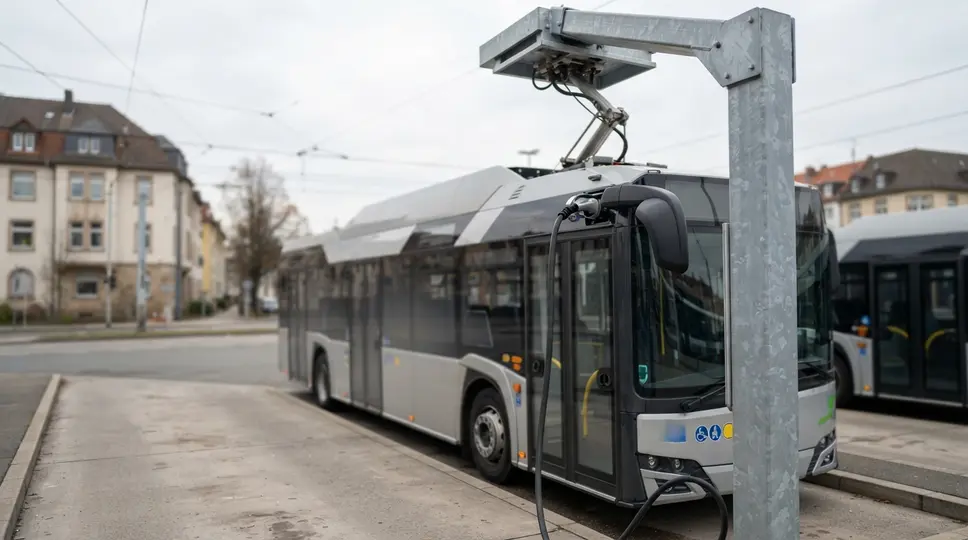
Jena, 06.07.2026 – The Jena City Council has passed a landmark resolution for the full electrification of the municipal bus fleet. Future vehicle acquisitions must be exclusively fully electric to advance local climate protection efforts.
- Resolution: Mandatory acquisition of fully electric buses during fleet renewal
- Stakeholders: Jenaer Stadtrat, Jenaer Nahverkehr, Stadtverwaltung Jena
- Conditions: Obligation to maximize the use of subsidies (federal/state), maintenance of current route network quality
- Timeline: Submission of an investment plan for vehicles, charging infrastructure, and workshops within six months
Political shift in the City Council: Consistent decarbonization
With this resolution, the Jena City Council is implementing a significant political shift in urban mobility. After efforts to decarbonize public transport (ÖPNV) had stalled in recent years, the committee is now setting clear guidelines for the future. Effective immediately, the requirement applies that decommissioned or defective diesel vehicles of the Jenaer Nahverkehr must be replaced exclusively by fully electric buses (BEV). This step is intended to accelerate the transition to emission-free urban transport and support the city’s local climate goals.
The decision comes in the context of a long-standing debate regarding the financing of the transition in propulsion technology. After the first electric buses were successfully integrated into regular service in 2023, no further acquisitions followed initially. In 2025, Jenaer Nahverkehr had stated that it would refrain from further e-buses for the time being due to a lack of necessary financial support from the federal and state governments. However, with the reopening of federal funding programs, the City Council now considers the time right to make the set goals binding.
Requirements for public transport: Subsidies and route quality
A central aspect of the City Council’s resolution concerns the economic security of the project. To keep the financial burden on the municipal budget as low as possible, the administration has been mandated to exhaust all available funding programs at the state and federal levels. Only through this maximum utilization of grants can the significant difference in acquisition costs between diesel and electric buses be compensated.
At the same time, the modernization of the fleet must not come at the expense of the citizens. As emphasized, the existing route offerings must be maintained in their usual quality and frequency without restriction. Reducing service levels to co-finance the more expensive electric buses is politically excluded. This presents Jenaer Nahverkehr with the demanding task of maintaining operational efficiency despite the technological transition.
Focus on infrastructure and reporting obligations
The transition of the fleet requires far more than just the purchase of new vehicles. The city administration and Jenaer Nahverkehr must now promptly develop a comprehensive overall concept. This must include detailed plans for the expansion of charging infrastructure at depots as well as within the city area. Furthermore, the transport operator’s workshops must be retrofitted for the maintenance of high-voltage systems, and staff must be trained accordingly.
The City Council has set a deadline for the administration: a concrete investment plan outlining the financial and logistical steps for the coming years must be presented within six months. This tight timeframe underscores the political determination to achieve results quickly following the delays of previous years. The resolution thus aligns with the overarching guidelines for urban development, as also discussed within the framework of initiatives such as the new Jena 2035 Strategie-Board.
🚗 Traffic & Everyday Impacts
The complete conversion of the Jena bus fleet to electric drive brings noticeable changes to everyday urban life:
- Noise reduction in the city area: Especially in narrow streets and residential areas, the elimination of diesel engines will contribute to a significant reduction in traffic noise.
- Adjustment of schedules: Since electric buses have different ranges compared to modern diesel vehicles, the schedules of Jenaer Nahverkehr must be precisely coordinated with charging times to avoid delays.
- Construction work for charging points: The installation of fast-charging stations at terminal stops may temporarily lead to minor civil engineering work in public spaces.
Source:
Politischer Beschluss: Jenas Stadtbusflotte soll elektrisch werden – electrive.net
Transparency note: This article was created automatically, editorially reviewed, and expanded with AI support.