
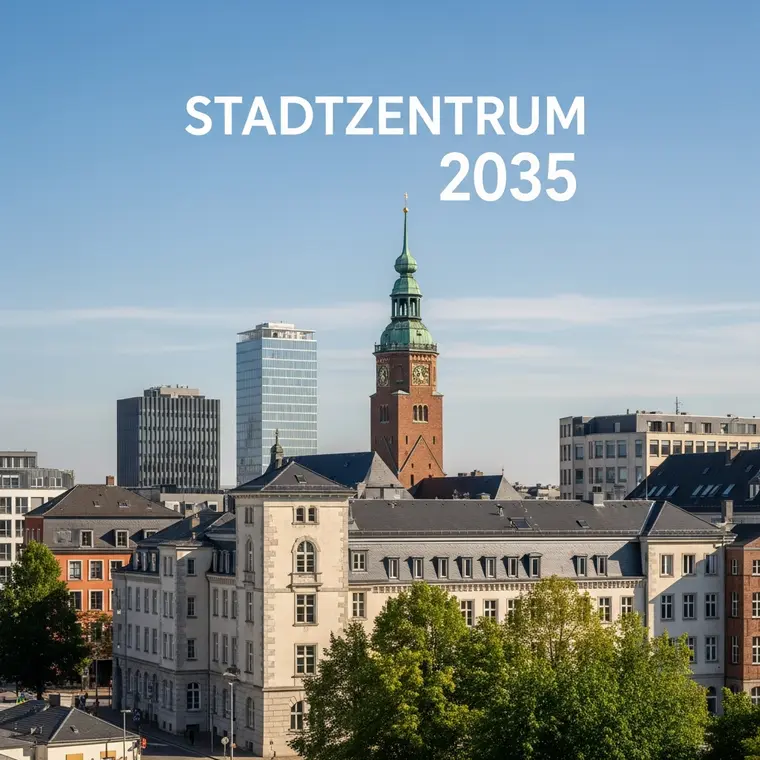
Jena, 24.05.2026 – The Jena urban development committee presented the final report on the new “Innenstadtvision 2035” at its most recent meeting. The concept, developed jointly with citizens and stakeholders, is intended to serve as a guiding principle for the future design and transformation of the Jena city center.
- Presentation date: 21.05.2026 (in the urban development committee)
- Initiators: City of Jena together with the Wirtschaftsförderung Jena (Start: early 2024)
- Participants: Over 40 stakeholders from administration, politics, business, culture, and civil society, as well as the general population
- Central pillars: Increasing the quality of stay, increased greening, flexible ground-floor use, consumption-free zones, strengthening the mix of uses (retail, culture, work, encounters)
- Official report: The complete final report can be viewed directly here digitally.
Setting the Course for the Jena Center of the Future
With the presentation of the final report on the “Innenstadtvision 2035,” the urban development committee has set an important course for the coming years. The concept marks a strategic realignment for the Jena city center. It outlines a detailed picture of how the heart of the Lichtstadt is to change over the next ten years. The goal is to make the city center more resilient to the nationwide structural change in retail and to further develop it into a multifunctional place of encounter.
Broad Participation as the Foundation of Planning
The development of the vision began in early 2024 at the initiative of the city administration and the Wirtschaftsförderung Jena (JenaWirtschaft). To develop a realistic concept supported by a broad social base, those responsible relied on an intensive participation process. More than 40 key stakeholders from the fields of city administration, local politics, local business, culture, and civil society organizations actively participated in various workshops and individual interviews.
Furthermore, the results of a comprehensive survey of the Jena population and external visitors were incorporated directly into the report. This ensured that the wishes of local people – from students to seniors – play a central role in the guiding principle.
The Core Goals: Green, Lively, and Flexible
The “Innenstadtvision 2035” defines the future center of Jena as “young, dynamic, and cosmopolitan.” To fill this image with concrete content, the report focuses on several strategic priorities:
- Mix of uses instead of mono-structure: Since traditional specialist retail is under increasing pressure, the center should be characterized much more strongly in the future by a lively mix of gastronomy, cultural offerings, services, flexible workplaces, and places of encounter.
- Quality of stay and greening: To counteract increasing heat in urban areas and make staying more attractive, the vision provides for increased greening and the expansion of shaded areas. Consumption-free areas are a focus here, in order to make the city center accessible to all social groups without the pressure to buy.
- Flexible ground-floor zones and pop-up concepts: Vacancies are to be actively avoided by allowing ground floors to be used more flexibly in terms of construction and law. Pop-up stores and temporary cultural projects are intended to provide an uncomplicated stage for new ideas and local founders and keep the shopping streets dynamic.
Long-term Significance for Jena City Life
The implementation of these guidelines will permanently change daily life in Jena. A greener and traffic-calmed city center not only promotes the microclimate in the densely built-up Saaletal but also invites people to stay longer. Ultimately, local gastronomy and the remaining retail will also benefit from this. By becoming a living, working, and cultural space in equal measure, the center retains its vitality even after traditional shop opening hours.
The city administration explicitly emphasizes, however, that the present document does not represent a rigid, unalterable construction plan. Rather, it serves as a dynamic foundation on which future city council resolutions and concrete urban development projects of the coming years can build.
🏛️ History & Urban Development: The Transformation of the Jena Center
The Jena city center looks back on a turbulent urban development history. Due to the heavy destruction in World War II and the subsequent socialist urban planning of the GDR – which culminated, among other things, in the construction of the striking Jentower in the 1970s – the historical cityscape was profoundly changed. Large open spaces such as the Eichplatz have since shaped urban development discussions about the right balance between modernity, monument protection, and usage requirements.
In recent decades, the focus has primarily been on closing gaps between buildings and revitalizing the historical core. With the “Innenstadtvision 2035,” the city is now responding to the global challenges of the 21st century: climate change and changing consumer behavior. The focus is thus shifting away from pure structural densification towards a targeted ecological and social upgrading of public space.
Source:
City of Jena presents Innenstadtvision 2035
Transparency Note: This article was created automatically, editorially reviewed, and expanded with AI support.