
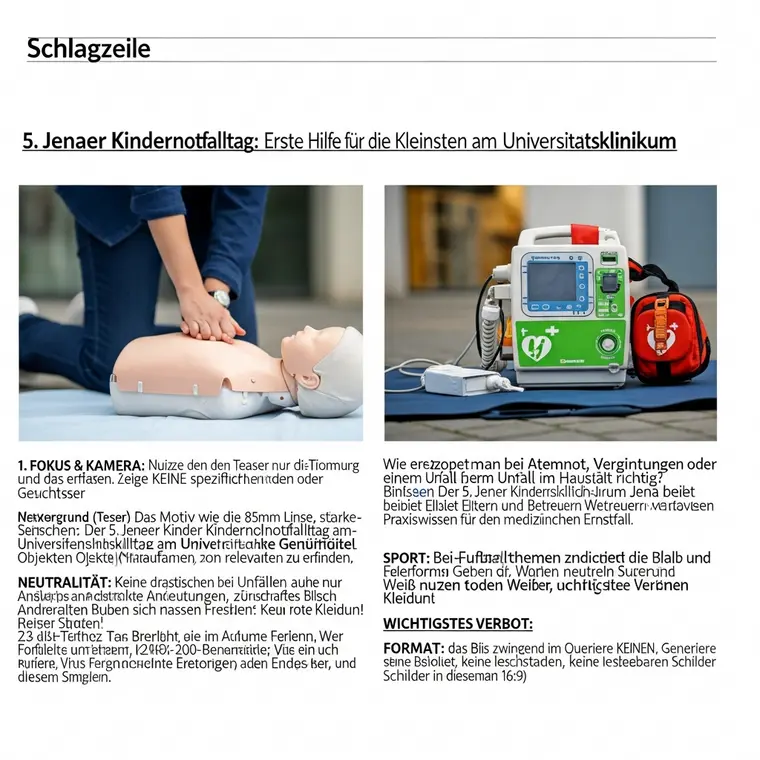
JENA, 02.06.2026 – To prepare parents, grandparents, and caregivers for medical emergencies involving babies and young children, the Universitätsklinikum Jena (UKJ) is hosting the 5. Jenaer Kindernotfalltag. This information offering provides essential tools for emergency situations.
- Event: 5. Jenaer Kindernotfalltag
- Location: Universitätsklinikum Jena, Am Klinikum 1, 07747 Jena (Show on Google Maps)
- Target Group: Parents, grandparents, educators, childminders, and all interested parties
- Time & Program: Current times and registration details can be viewed directly on the website of the Universitätsklinikum Jena.
Practical and Educational Benefits for Everyday Life
A medical emergency involving a child represents an extreme psychological burden for parents and caregivers. The educational approach of the Kindernotfalltag aims to reduce inhibitions and fears. Since the organism and anatomy of infants and young children differ fundamentally from adults, standard first aid measures are often not directly transferable.
Through practical demonstrations, participants learn to assess dangerous situations in everyday life more quickly and to react calmly. The teaching of clearly structured procedures ensures that no valuable time is lost before the arrival of the emergency services.
Key Topics and Program Points
The event covers a wide range of typical emergency scenarios. Experienced doctors and nursing staff from the UKJ demonstrate life-saving techniques directly on-site. The most important training contents include:
- Airway Relief: Correct action in case of swallowing and threat of choking (aspiration).
- Resuscitation Training: Cardiopulmonary resuscitation specifically adapted for infants and young children.
- Thermal and Chemical Trauma: First aid for burns, scalds, and poisoning in the household.
- Acute Illnesses: Recognition and initial care of febrile seizures, pseudocroup attacks, and allergic reactions.
🛡️ Prevention & Advice: Minimizing Accident Risks in the Household
The majority of all accidents in infancy and early childhood occur in the home environment. In addition to rapid first aid, preventive securing of the home is the most effective protection. This includes the complete installation of socket covers, securing window handles, and strictly storing household chemicals, medicines, and small parts out of the reach of children.
Source:
5. Jenaer Kindernotfalltag
Transparency Note: This article was automatically created, editorially reviewed, and expanded with AI support.