
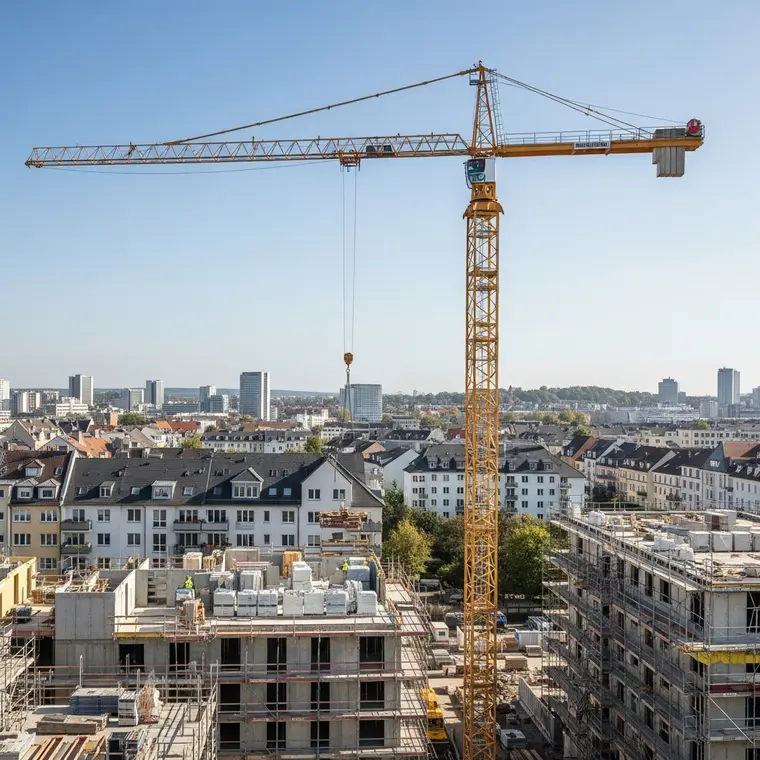
Jena, March 18, 2026. High rents and an extremely tight housing market are putting the university city under increasing pressure. To approve and implement construction projects significantly faster in the future, the city administration is now making extensive use of the so-called „Bauturbo“.
- The Topic: Use of the „Bauturbo“ to accelerate construction projects in Jena
- The Initial Situation: Only 1.8 percent vacancy on the Jena housing market; rental prices for new buildings often at 15 euros per square meter
- The Measure: Utilization of the Baugesetzbuch amendment (October 2025) to reduce bureaucracy
- Responsible: Dirk Lange, Head of Department for Urban Development and Environment
Jena struggles with the title „Munich of the East“
Jena is young, growing, and remains highly attractive as a university and technology location. However, this appeal comes at a price: The housing market is almost empty, with the vacancy rate at a concerning 1.8 percent. This is felt primarily by citizens looking for affordable living space.
As Dirk Lange, Jena’s Head of Department for Urban Development and Environment, regretfully notes, the city simply has too little social housing. Anyone building today or renting a first-time occupancy quickly ends up with prices around 15 euros per square meter. For students, families, or people with low and middle incomes, the air in the Saalestadt is becoming increasingly thin. It is not without reason that Jena is often referred to as the „Munich of the East“ – a label that aptly summarizes the tense situation.
The „Bauturbo“ as a new acceleration instrument
To counter this downward trend in affordable housing, Jena is now taking the lead. As one of the few municipalities, the city addressed the „Bauturbo“ early on, according to Lange, and is now using it intensively while other cities are still waiting.
The background is the amendments to the Baugesetzbuch passed in October 2025. This mechanism, promoted by the federal government as a „new and bold instrument,“ allows municipalities to create building rights faster than before in areas with a severely strained housing market. The declared goals of the Bauturbo are to bypass lengthy planning procedures and to increase the density of already built-up areas. For concrete implementation, the city of Jena has now established binding guidelines according to which new construction projects can be evaluated and approved more quickly.
Background: Housing construction and topography in Jena
The tense housing situation in Jena is largely due to its geographical location. Nestled in the deep Saaletal and flanked by the Muschelkalk slopes, the city’s natural expansion possibilities are strictly limited. To absorb the massive population growth of the flourishing optics and glass industry in the 20th century, large residential estates such as Lobeda and Winzerla were built in the 1960s and 70s.
Today, as the city can hardly develop new areas on the outskirts, urban development focuses primarily on so-called Nachverdichtung (infill development). This refers to building on vacant lots, adding floors to existing buildings, or converting former industrial brownfields. Especially for such often complex inner-city projects, the „Bauturbo“ is intended to facilitate the planning law path.
Source:
How municipalities are concretely implementing the Bauturbo
Transparency Note: This article was created automatically, editorially reviewed, and expanded with AI support.