
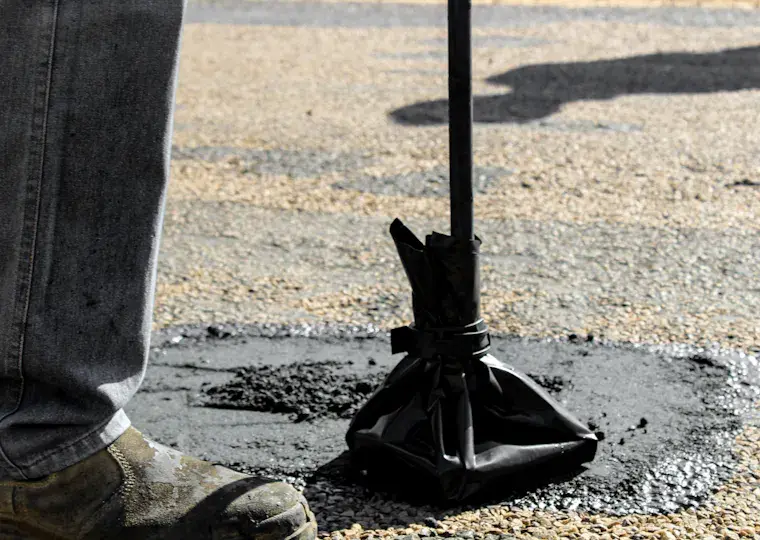
Jena, March 26, 2026 – Following the long frost period in January, Kommunalservice Jena (KSJ) is tackling the numerous road damages across the city area. Particularly the heavily used Camburger Straße in the north of Jena is the focus of current repair work, which will continue for several weeks.
- What: Removal of serious winter damage (cracks, potholes).
- Where: Current focus on Jena-Nord (Camburger Straße), as well as asphalt renewal at Fürstengraben (B7).
- Who: Repair crews from Kommunalservice Jena (KSJ).
- Duration: Several weeks, involving temporary closures and diversions.
Camburger Straße remains a patchwork for now
In the north of the city, KSJ has already begun filling potholes. Christopher Helbig, Head of Civil Engineering and Urban Space, explained that Camburger Straße currently has the highest priority. A literal pothole track had developed there during the past winter months, leading to the maximum speed limit being reduced to 30 km/h in sections.
A three-person repair crew was already in action on Wednesday to close the craters with hot-mix asphalt. However, due to the onset of rain showers, the work had to be interrupted. Repairs are scheduled to continue next week. According to Helbig, the road is a real problem child: the cause of the recurring cracks and deformations is an asphalt layer that is too thin, applied over old basalt paving. A fundamental renovation is not planned here until 2028. Until then, regular patching is the only option.
Deficiency reporter and digital maps reveal the extent
The extent of the frost damage is particularly clear this year. The city administration’s “Mängelmelder” (deficiency reporter), through which citizens can report road damage online, is currently running hot. Experts are evaluating the reports and using a Geographic Information System (GIS) to create digital maps of the network of around 1,000 streets in Jena and its districts.
Helbig confirms that the damage is more severe than in previous years. However, permanent relief requires favorable weather conditions: repairs can only take place in dry weather and stable positive temperatures. A clear prioritization applies during processing: public transport routes (bus lines) and federal roads are repaired first.
Asphalt supply and parallel major construction site at Fürstengraben
Since the municipal service does not operate its own asphalt mixing plant – which, according to Helbig, would not be profitable – the required hot-mix asphalt must be sourced from external construction companies. Drivers must be prepared for city-wide repairs to continue for weeks, repeatedly leading to temporary diversions.
In addition to the winter damage, regular renovation work is currently underway on one of the city’s main traffic arteries. At Fürstengraben, a section of the federal highway 7 (B7), the top asphalt layer is being milled off and completely renewed between the intersection of Löbdergraben/Saalbahnhofstraße and Bibliotheksplatz. This work is expected to be completed by April 10.
Jena’s topography in the narrow Saaletal makes the city’s main traffic arteries particularly sensitive to restrictions. Camburger Straße serves as an essential north-south connection for commuters and residents of the northern districts such as Zwätzen and Löbstedt. It relieves the parallel federal highway B88. Fürstengraben, as part of the B7, is the central east-west transit artery on the edge of the historic old town. Experience shows that construction work at these bottlenecks quickly leads to noticeable delays in rush-hour traffic. With the “Mängelmelder,” the city relies on digital citizen participation: via the city portal, residents can report defective streetlights, waste, or potholes directly to the Kommunalservice, including photos and GPS coordinates, which significantly facilitates the prioritization of repair crews.
Source:
How winter damage to roads is to be repaired in Jena
Transparency note: This article was created automatically, editorially reviewed, and expanded with AI support.