
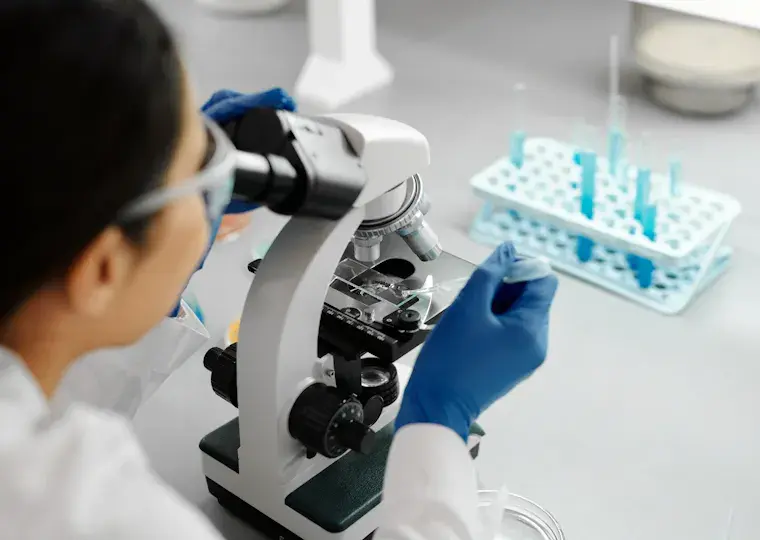
Jena/München, March 19, 2026. Researcher Dr. Anne-Sophie Munser has been honored for the development of a new technology for the rapid analysis of bacteria and resistances. She received the prestigious Hugo Geiger Prize in München.
- Award: 3rd place of the Hugo Geiger Prize
- Awardee: Dr. Anne-Sophie Munser (Fraunhofer IOF)
- Innovation: Highly sensitive scattered light measurement for rapid bacterial and resistance analysis
- Presentation: March 18, 2026, Fraunhofer Network Symposium in München
Promising Perspectives for Infection Research
The highly sensitive scattered light measurement developed by Dr. Anne-Sophie Munser represents a significant technological advancement in medical diagnostics. With the new procedure, microorganisms, bacteria, and especially antibiotic resistances can be analyzed much faster and more precisely than with the standard procedures currently common in laboratories. For this achievement, she was presented with third place of the Hugo Geiger Prize during the Fraunhofer Network Symposium on Wednesday.
The technology from the Jena Fraunhofer Institute for Applied Optics and Precision Engineering (IOF) opens up new and far-reaching perspectives for infection research. Especially in the field of diagnostics, the time factor is crucial to be able to treat patients with the most effective medications as quickly as possible.
Background: Optics Research at Beutenberg and the Danger of Resistances
The Fraunhofer IOF, where the award-winning research took place, is headquartered at the Beutenberg Campus in Jena. This location bundles a large part of the natural science and medical research of the “Lichtstadt.” Innovations in the field of photonics (optical technologies) play an increasingly central role in solving medical challenges.
The rapid analysis of pathogens is vital in modern medicine. According to the World Health Organization (WHO), antibiotic resistance is considered one of the greatest global health threats of the 21st century. Conventional methods for determining resistance are often based on the lengthy cultivation of pathogens in nutrient solutions – a process that can take days. Optical methods such as the scattered light method can drastically shorten this period. The faster a pathogen and its potential resistances are determined, the earlier a targeted and life-saving antibiotic therapy can begin for the patient. This not only prevents severe disease progression but also curbs the further spread of resistant germs.
Source:
Scattered light method enables faster analysis of bacteria and resistances
Transparency note: This article was created automatically, editorially reviewed, and expanded with AI support.