
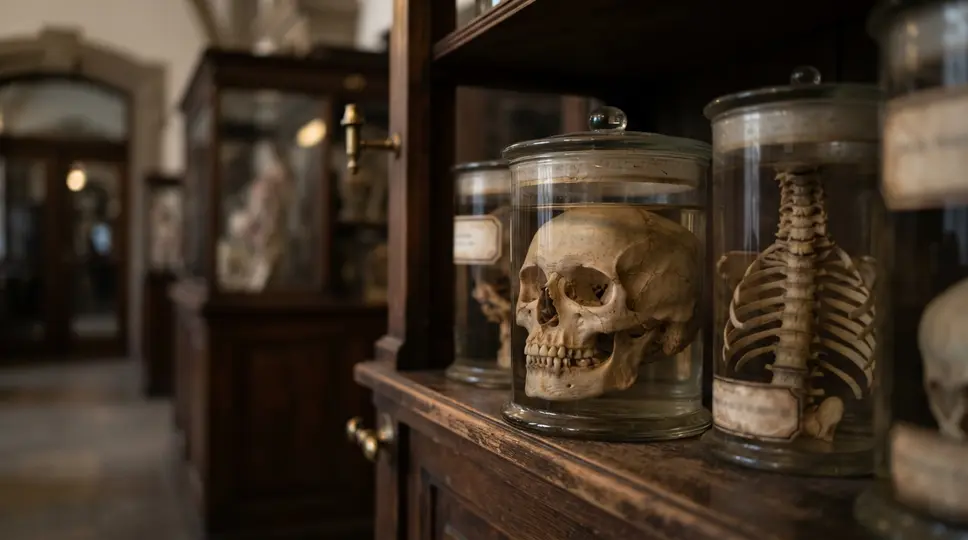
Jena, July 11, 2026 – The traditional Anatomical Collection of the Friedrich-Schiller-Universität Jena is opening its doors again this Saturday. The historical permanent exhibition offers visitors interested in science and cultural history a deep insight into human anatomy and the rich research history of the city on the Saale.
- What: Anatomical Collection Jena (permanent exhibition)
- Where: Institut für Anatomie, Teichgraben 7, 07743 Jena (plan your route via Google Maps)
- When: Every Saturday from 10:00 a.m. to 1:00 p.m. and Wednesdays from 2:00 p.m. to 5:00 p.m.
- Admission: Free
- Contact: Phone 03641 9-396110 | Website: uniklinikum-jena.de/anatomie1
History of Science and Goethe’s Discoveries
The collection, which is over 200 years old, houses a multitude of artistic specimens and clear models that illustrate the biological foundations of the human body. A special highlight of the exhibition are the original intermaxillary bone specimens by Johann Wolfgang von Goethe. These historically invaluable exhibits testify to Goethe’s own anatomical research in Jena, during which he proved the existence of the intermaxillary bone in humans in 1784 – a milestone in comparative anatomy.
Duty of Respectful Conduct
Since the exhibition displays real body parts and specimens of deceased individuals, the institute’s management explicitly points out the duty of respectful conduct throughout the exhibition area. The museum serves both learning and commemoration. For families, there is a special regulation: children up to the age of 12 are only admitted when accompanied by an adult supervisor.
Those planning further weekend activities in Jena after their museum visit can find diverse leisure activities in the city area, for example at the flea markets in Jena.
Exhibition Details at a Glance
The exhibition is an excellent sophisticated indoor activity for rainy days. Key information for your visit at a glance:
- Regular opening hours: Wednesdays (2:00 p.m. – 5:00 p.m.) and Saturdays (10:00 a.m. – 1:00 p.m.).
- Target group: Students, school classes, those interested in history, and the general public.
- Accessibility & Rules: Please ensure appropriate quiet and decorum on-site; photography is not permitted out of respect for the privacy of the body donors.
🏛️ History & Building: The Legacy of FSU Jena
The Institut für Anatomie at Teichgraben looks back on a centuries-old tradition. As early as the late 18th century, the Jena anatomy department was one of the most advanced research facilities in the German-speaking world. The close integration of natural sciences and the classical humanities, shaped by personalities such as Goethe, Schiller, and the anatomist Justus Christian Loder, makes the historical building a significant site of memory in European history of science.
Source:
Anatomical Collection Jena – Permanent Exhibition
Transparency note: This article was created automatically, editorially reviewed, and expanded with AI support.