
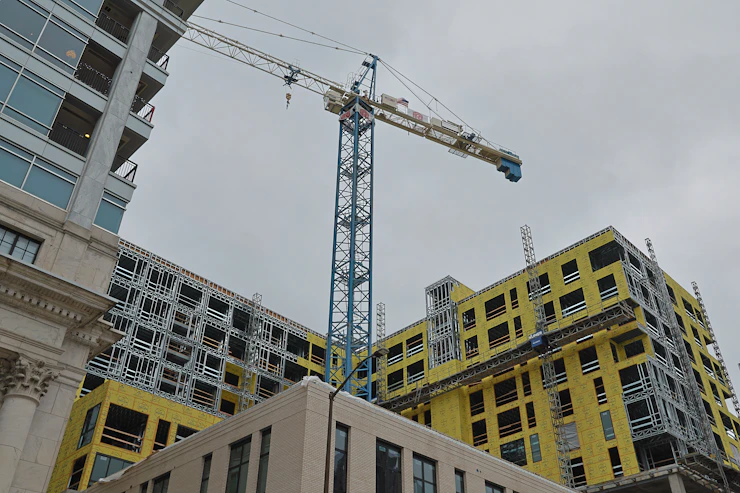
- Goal: 5,000 new apartments planned by 2035.
- Current status: Only around 230 units were completed last year.
- Strategy: Application of the federal “Bauturbo” only under strict municipal guidelines.
- Focus: Infill development and adding floors instead of unregulated new construction areas.
Jena (20.02.2026) – The housing market in the Saalestadt remains tense. The geographic basin location and the ongoing influx have posed challenges for urban planners for years. The city administration’s stated goal is ambitious: 5,000 new apartments are to be built by the year 2035 to meet demand and stabilize rents. However, there is a gap between plan and reality. Last year, only about 230 new residential units were completed – significantly too few to reach the long-term goal at the planned pace.
The “Bauturbo” and Jena’s Skepticism
To boost housing construction nationwide, the federal government launched the so-called “Bauturbo” (§ 246e BauGB). This law is intended to enable municipalities to approve construction projects faster by bypassing time-consuming development plan procedures under certain circumstances. What sounds like a quick solution in theory is met with reservation in the Jena urban development department.
The city administration has decided not to adopt the federal instrument unchecked, but rather to “tame” it, so to speak. The Bauturbo is to be used in Jena only with the handbrake applied and under the application of its own municipal guidelines. The concern of those responsible: An unregulated construction boom could sacrifice urban planning qualities and create more problems in the long term than it solves.
Quality over Quantity: Filling Gaps instead of Sealing Surfaces
Jena is relying on a strategy of small steps. Instead of designating huge new areas without detailed preliminary planning, the focus is on smaller projects. The magic word is infill development (Nachverdichtung). Specifically, this means:
- Closing construction gaps: Vacant plots in existing areas are to be built upon.
- Adding floors: Existing buildings could receive additional floors where this is structurally and visually justifiable.
- Repurposing: Commercial spaces that are no longer needed could be converted into living space.
There are compelling reasons for this approach. In the narrow valley location of Jena, open spaces are a precious commodity. In particular, the fresh air corridors, which are essential for the city’s climate, must not be built over recklessly. The architectural cityscape should also not suffer from hasty decisions. The city administration wants to prevent investors from using the “Bauturbo” to push through projects that do not fit harmoniously into the existing neighborhoods.
Outlook: A Balancing Act between Need and Caution
For builders and investors, the Jena way means that despite the theoretical acceleration possibilities of the federal law, strict standards continue to apply in the Saalestadt. The administration is thus signaling clearly: creating living space yes, but not at any price. Whether the mark of 5,000 new apartments by 2035 can actually be reached by focusing on small-scale projects remains to be seen. It is a balancing act between the urgent social need for housing and the preservation of quality of life in a geographically limited city.
The city administration remains challenged to moderate this process transparently in order to do justice to both those seeking housing and the residents.
Source:
Turbo for housing construction: Jena relies on small projects instead of large plans
Transparency note: This article was created automatically, editorially reviewed, and expanded with AI support.